This article first appeared on the World Economic Forum Agenda, and was co-authored by UN Envoy on Youth Jayathma Wickramanayake and ILGA World Youth Steering Committee. We republish it in accordance with the Creative Commons Attribution-NonCommercial-NoDerivatives 4.0 International Public License.
Photo by United Nationsan international organisation comprising 193 member States. It has the mission of maintaining peace and security, protecting human rights, providing humanitarian aid and ensuring economic and social development across the globe. It is a network of many different bodies and agencies, each of which has a particular role and responsibility. More COVID-19 Response on Unsplash
- The loss of safe spaces and support services has further marginalized LGBTIQ people during the pandemic
- Legal rights and protections, especially of transadjective/umbrella term to describe a person whose gender identity does not match the sex they were assigned at birth. More people, are also under attack
- LGBTIQ leaders are stepping up, but more measures are needed
Pride Month is a crucial time of the year for queer communities and allies to honour the road towards equality walked thus far, celebrate diversity, and speak up about the injustices and prosecutions they continue to face as part of everyday life.
For young lesbianadjective/noun to describe a woman whose enduring physical, romantic, and/or emotional attraction is to other women. Women and non-binary people may use this term to describe themselves. More, gayadjective to describe people whose enduring physical, romantic, and/ or emotional
attractions are to people of the same gender. Men, women and non-binary people may use this
term to describe themselves. More, bisexualadjective used to describe a person who has the capacity to form enduring physical, romantic, and/ or emotional attractions to those of the same gender or to those of other genders. More, trans, intersexan umbrella term for the spectrum of variations of sex characteristics that naturally occur within the human species. Intersex people are born with variations of sex characteristics (such as genitals, reproductive organs, hormonal and chromosomal patterns) that are more diverse than stereotypical definitions of male or female bodies. Up to 1.7% of the global population are born with such traits; yet, because their bodies are seen as different, intersex children and adults are often stigmatised and subject to harmful practices – including in medical settings - and discriminated against. More and gender-diverse (LGBTIQ) people, this is an important time to feel less isolated, see more representation and support, and sometimes even to come out. However, not only has COVID-19 cancelled most of the celebrations, measures to combat the pandemic have also created an environment where their rights are further being violated.
Young queerpreviously used as a derogatory term to refer to LGBT individuals in the English language – and still perceived as offensive by some - queer has been reclaimed by people who identify beyond traditional gender categories and heteronormative social norms. Although not universally accepted, it is often used as a catch-all to include many people within the larger community of people with diverse sexual orientations, gender identities and expressions, and sex characteristics. More people rely on safe and inclusive youth LGBTIQ centres, groups and specialist support services that affirm their identities, where they can be their true selves, relate to others, and learn and socialize in a safe, non-judgemental space and environment.
But despite being an essential service, a large part of LGBTIQ youth organizations and networks across the world are voluntarily led, operating with minimum to no finances. Some of them have successfully moved into digital spaces after COVID-19, but many others have had to close down, leaving a large number of young queer people without any support. In contrast to the popular myth that all youth are digitally connected, many young LGBTIQ people have no access to the internet and are digitally excluded. For others, online platforms are not safe spaces to be: This is where they can face abuse, harassment or get outed. Being on online platforms can also be a triggering experience and reminder of past trauma.
Due to the COVID-19 pandemic, the demand and need for support services has increased. For many young queer people, lockdown has equalled being trapped in hostile environments with abusive families and partners, with no help at hand. A survey on LGBTIQ adolescents and youth in south-east and east Asia, for example, showed that 62% of respondents were concerned about their mental health during the pandemic. As 65.4% of respondents were still living at home with parents, one of the most pressing concerns was to have their identities disclosed, with no peer support available.
We have seen an increase in violence – particularly targeting young trans women, young gender-diverse people of colour, and young LGBTIQ migrants and refugees, who often cannot access neither mainstream service provision nor specialist support. Homelessness and unemployment are disproportionately affecting queer youth, leaving many without access to basic needs such as food and shelter. With increased demand but limited access, LGBTIQ young people who are struggling with poor mental health are left with no support.
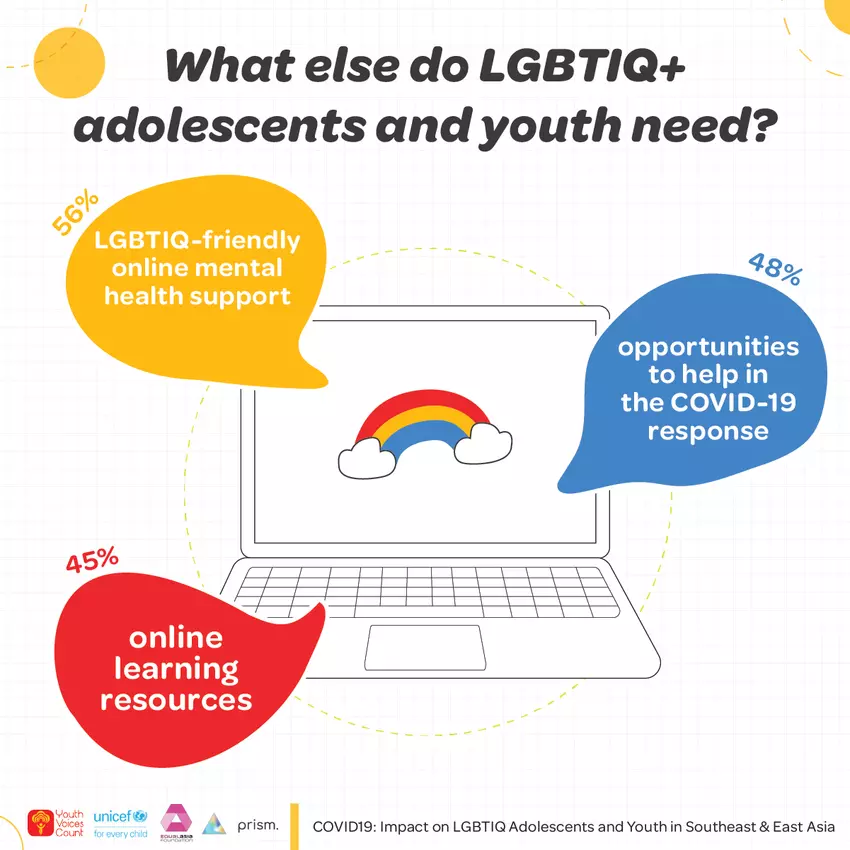
Last year during the Nairobi Summit on the International Conference on Population and Development, we saw a strong call to focus on the distinct needs and rights of LGBTIQ youth. However, it seems that the COVID-19 pandemic has only exacerbated their challenges and silenced them further. Why does the world tend to forget the most marginalized when crises occur?
Isolation is not new to many queer youth: Many grow up experiencing it and living in it. However, the pandemic has caused additional barriers and discriminationunequal or unfair treatment which can be based on a range of grounds - such as age, ethnic background, disability, and diverse sexual orientations, gender identities and expressions or sex characteristics, amongst others. More, and has driven LGBTIQ youth issues further into the shadows. The pandemic supercharged already existing inequalities, and provided a perfect storm for increased hateful rhetoric and new regressive policies around the world.
We are worried by the recent dangerously regressive rhetoric and trend of removing legal recognition and protections, of trans youth especially.
To name some of the most recent cases, a new bill in Hungary – advanced and signed into law during the COVID-19 pandemic – made legal recognition impossible. In India, many trans people saw their livelihoods increasingly at risk, while being targeted in a malicious campaign accusing them of spreading the virus. Stakeholders need to protect LGBTIQ youth rights, bodies and lives, not introduce new harmful practices in times of crisis.
Sidelined and ignored despite their repeated calls to be included in decision-making fora, youth queer activists around the world have nevertheless stepped up to lead. They provide vital peer and crisis support for communities that their governments have largely disregarded. In Argentina, young people are raising funds to buy and distribute food and supplies to LGBTIQ people in need. A young activist from Togo is co-chairing the umbrella LGBTIacronym for lesbian, gay, bisexual, trans and intersex people. Although this is not the acronym available to describe people of diverse sexual orientations, gender identities and expressions, and sex characteristics, it is the most commonly used in United Nations spaces and advocacy. More network for Africa, Pan Africa ILGA, which puts together conferences and supports grassroots queer activists and organizations across the region. In Kiribati, a youth organization has concluded a one-year project offering practical tips on inclusive education to people who work in social services, health, education and sport, by using examples and campaigns developed in the Asia-Pacific region.
Moving forward, we need to invest more into LGBTIQ youth services and spaces. Not only are they essential, but often the only life-saving support young queer people can get when forced into hostile environments. Now more than ever, we need to ensure that queer youth voices are not only included, but have an active part in the decision-making and conversations that will impact their lives. They need spaces and structures for them to work together and advocate their rights, both online and in person. Finally, the international community must hold governments accountable and insist on implementing measures that protect young people against violence and discrimination based on sexual orientationrefers to a person’s capacity for profound emotional, affectional and sexual attraction to - and intimate and sexual relations with - individuals of a different gender or the same gender or more than one gender. More, gender identityrefers to a person’s deeply felt internal and individual experience of gender, which may or may not correspond with the sex assigned at birth. More and expression, and sex characteristicsa term that refers to physical features relating to sex - including genitalia and other sexual and reproductive anatomy, chromosomes, hormones, and secondary physical features emerging from puberty. More.