Summary
ILGA will share articles from The Economist ahead of its Pride and Prejudice event throughout spring 2018. Excerpts shared with kind permission of the publisher
IN THE West, few civil-rights movements have prevailed so quickly and comprehensively as the campaign for gayadjective to describe people whose enduring physical, romantic, and/ or emotional
attractions are to people of the same gender. Men, women and non-binary people may use this
term to describe themselves. More rights. In America, support for same-sex marriage has shot up from 27% to 64% since 1996—faster than the rise in acceptance of interracial marriage beginning in the late 1960s. Ireland has gone from having few openly gay public figures to legalising gay marriage and having a gay prime minister.
But what about the rest of the world? How do Chinese or Peruvian people feel about gay rights? For that matter, what about the inhabitants of Angola? The International Lesbianadjective/noun to describe a woman whose enduring physical, romantic, and/or emotional attraction is to other women. Women and non-binary people may use this term to describe themselves. More, Gay, Bisexualadjective used to describe a person who has the capacity to form enduring physical, romantic, and/ or emotional attractions to those of the same gender or to those of other genders. More, Transadjective/umbrella term to describe a person whose gender identity does not match the sex they were assigned at birth. More and Intersexan umbrella term for the spectrum of variations of sex characteristics that naturally occur within the human species. Intersex people are born with variations of sex characteristics (such as genitals, reproductive organs, hormonal and chromosomal patterns) that are more diverse than stereotypical definitions of male or female bodies. Up to 1.7% of the global population are born with such traits; yet, because their bodies are seen as different, intersex children and adults are often stigmatised and subject to harmful practices – including in medical settings - and discriminated against. More Association (ILGA) has released some numbers that provide a tantalising hint, if not much more than that.
Continue reading the article: click here
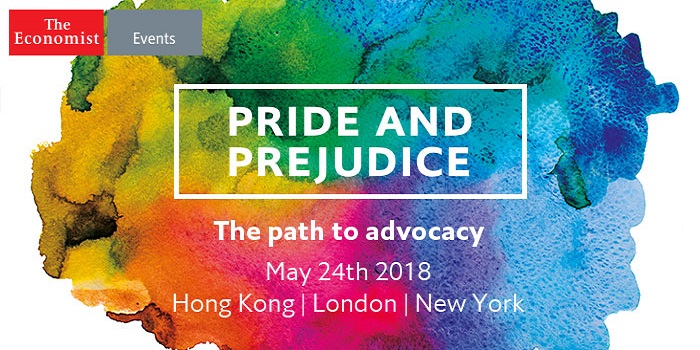
ILGA supports Pride and Prejudice, a global initiative organised by The Economist Events that will catalyse fresh debate on the economic and human costs of discriminationunequal or unfair treatment which can be based on a range of grounds - such as age, ethnic background, disability, and diverse sexual orientations, gender identities and expressions or sex characteristics, amongst others. More against the LGBT community.
The 24-hour event taking place on 24 May 2018 will begin in Hong Kong, continue in London and end in New York.
Find out more about Pride and Prejudice here.