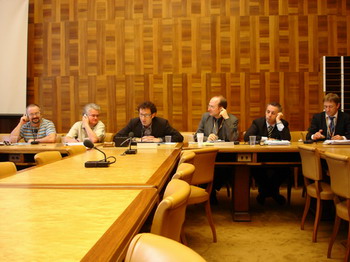
The rejection by the ECOSOC Committee on Non-governmental Organizations of the applications of four LGBT organizations, including ILGA, for consultative status in 2006 has underlined that many states are not even willing to give LGBT people the right to speak at the UN. In the course of 2005 and ILGA organized a campaign for eleven LGBT associations from Africa, Europe, Latin America and North America to apply for ECOSOC status. ILGA was denied this right in July 2006 by the full ECOSOC, in spite of the strong case made in their favour by some government officials. The Danish association LBL, ILGA-Europe and the German LSVD will be voted on again by ECOSOC later this year. This panel will give the various organizations involved in the ECOSOC process an opportunity to shed some light on the issues and provide a forum for debate on the rights and presence of LGBT people at the UN.
Friday 6 October 2006 : from 2 to 3 PM. Palais des Nations, 2nd session of the UN Human Rights Councilan inter-governmental body within the United Nations which has the responsibility to promote and protect human rights. It is comprised of 47 member States, each elected to 3-year terms by the 193 member States of the United Nations. More Side Event
A panel organised by ILGA, the International Lesbianadjective/noun to describe a woman whose enduring physical, romantic, and/or emotional attraction is to other women. Women and non-binary people may use this term to describe themselves. More and Gayadjective to describe people whose enduring physical, romantic, and/ or emotional
attractions are to people of the same gender. Men, women and non-binary people may use this
term to describe themselves. More Association. In collaboration with the Swedish Association for Sexuality Education and RFSL, the Swedish Gay and Lesbian Federation.
With the financial support of the Swedish Foreign Office
Chair
Janfrans Var der Eerden, COC
Speakers
Click on their names to read the speeches. Audio material sometimes available.
This is the first time in twelve years that ECOSOC is not closing the NGO Committee chapter. So, in a sense, we have taken issue here that the UN will have to deal with.
Philipp Braun, LSVD, Germany and ILGA’s Co-Secretary General
We have consultative status at the Council of Europe (…). So from our perspective, we think that we have good standing; and our expertise contribution as an NGO is recognized throughout all of the key European institutions. We applied to have status at ECOSOC (…)
Jackie Lewis, Unison, UK
Avec le langage onusien, tout est toujours très poli, mais c’est ce qui est sous-jacent derrière leurs questions qui est important…
Yvan Lapointe, Coalition Gaie et Lesbienne du Quebec
These struggles at the ECOSOC are a bit of a microcosm of the struggles currently being faced within the United Nationsan international organisation comprising 193 member States. It has the mission of maintaining peace and security, protecting human rights, providing humanitarian aid and ensuring economic and social development across the globe. It is a network of many different bodies and agencies, each of which has a particular role and responsibility. More system as a whole.
John Fisher, ARC International
The end of discriminationunequal or unfair treatment which can be based on a range of grounds - such as age, ethnic background, disability, and diverse sexual orientations, gender identities and expressions or sex characteristics, amongst others. More starts with dialogue with the States, showing them the situations where LGBT persons’ human rights are violated, the absurdity of these situations and the need to apply laws and resolutions equally to all persons
Beto de Jesús, Instituto Neris, Brazil