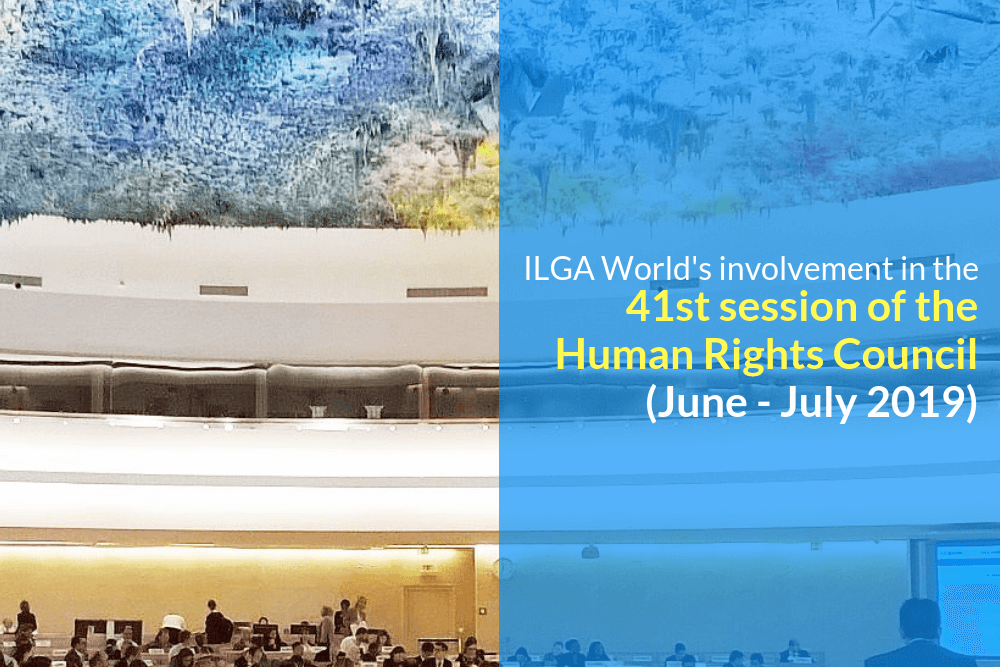
ILGA’s involvement at the 41st session of the Human Rights Council (HRC)
A summary of SOGIESCabbreviation standing for sexual orientation and gender identity & expression, and sex characteristics. More issues mentioned in the reports presented during the 41st Human Rights Councilan inter-governmental body within the United Nations which has the responsibility to promote and protect human rights. It is comprised of 47 member States, each elected to 3-year terms by the 193 member States of the United Nations. More session is available here. The notes from the Interactive Dialogue with the Independent Expert on SOGI are available here.
In this section:
Statements at the HRC
- Interactive dialogue with the Independent Expert on violence and discriminationunequal or unfair treatment which can be based on a range of grounds - such as age, ethnic background, disability, and diverse sexual orientations, gender identities and expressions or sex characteristics, amongst others. More based on SOGIand the Special Rapporteur on the independence of judges and advocates
- Interactive dialogue with the Independent Expert on violence and discrimination based on SOGIand the Special Rapporteur on the independence of judges and advocates (Transadjective/umbrella term to describe a person whose gender identity does not match the sex they were assigned at birth. More Advocacy Week statement)
- Item 3 – Clustered interactive dialogue with Special Rapporteur on Health and Special Rapporteur on Leprosy
- Clustered interactive dialogue: Working Group on discrimination against women and Working Group on business and human rights
- Clustered interactive dialogue: Special Rapporteur on violence against women and Special Rapporteur on trafficking
- Panel discussion on women’s rights and climate change
- Item 8 – General Debate
- Annual thematic panel discussion on technical cooperation in the promotion and protection of human rights -Technical cooperation and capacity-building in the field of the human rights of older persons
- End of session
Side events
- (25 June 2019) ‘Hear us, See us’: A panel discussion with indigenous women from around the world
- (27 June 2019) Research and data collection on sexual orientationrefers to a person’s capacity for profound emotional, affectional and sexual attraction to - and intimate and sexual relations with - individuals of a different gender or the same gender or more than one gender. More and gender identityrefers to a person’s deeply felt internal and individual experience of gender, which may or may not correspond with the sex assigned at birth. More: needs, risks and best practices
- (02 July 2019) Religious communities affirming LGBTIQ people around the world
- (03 July 2019) Why renew the mandate of the SOGIabbreviation standing for sexual orientation and gender identity More IE? Focus on genderrefers to a social construct which places cultural and social expectations on individuals based on their assigned sex. More identity and human rights
Adoption of UPR outcomes
- Viet Nam
- Cambodia
Open letters to States
- On preventative engagement with, and action on, Tanzania at the Human Rights Council’s 41st session
Statements at the HRC
(statements will be added as the session unfolds)
INTERACTIVE DIALOGUE WITH THE INDEPENDENT EXPERT ON VIOLENCE AND DISCRIMINATION BASED ON SOGIAND THE SPECIAL RAPPORTEUR ON THE INDEPENDENCE OF JUDGES AND ADVOCATES
In this joint statement by ILGA-Europe and ILGA World, we highlighted how our life stories bear witness to the damage caused by prejudice against our expressions, identities, loves and relations, and we called on States to collect information to understand the scale of the discrimination and violence that we suffer.
Click here to read the statement (in Spanish).
INTERACTIVE DIALOGUE WITH THE INDEPENDENT EXPERT ON VIOLENCE AND DISCRIMINATION BASED ON SOGI AND THE SPECIAL RAPPORTEUR ON THE INDEPENDENCE OF JUDGES AND ADVOCATES (TRANS ADVOCACY WEEK STATEMENT)
In this statement, the trans and gender-diverse human rights defenders participating in this year’s Trans Advocacy Week urged member States to collect and analyse disaggregated data on issues affecting trans and gender-diverse people – including access to education, employment, health, housing, safety, and justice, as well as intersectional discrimination and violence.
Click here to read the statement or watch the video below
CLUSTERED INTERACTIVE DIALOGUE WITH SPECIAL RAPPORTEUR ON HEALTH AND SPECIAL RAPPORTEUR ON LEPROSY
In this statement, trans and gender diverse activists participating in Trans Advocacy Week expressed their concern for mental health care used as weapon in the form of forced institutionalization and treatment against trans and gender diverse people: “As affirmed by the World Health Organization, our gender identities and expressions aren’t pathologies to be treated but healthy manifestations of human diversity.
Click here to read the statement or watch the video below
CLUSTERED INTERACTIVE DIALOGUE: WORKING GROUP ON DISCRIMINATION AGAINST WOMEN AND WORKING GROUP ON BUSINESS AND HUMAN RIGHTS
In this statement, prepared in consultation with La Red Lésbica Cattrachas from Honduras, we highlighted the number of factors aggravating the risk for lesbianadjective/noun to describe a woman whose enduring physical, romantic, and/or emotional attraction is to other women. Women and non-binary people may use this term to describe themselves. More and bisexualadjective used to describe a person who has the capacity to form enduring physical, romantic, and/ or emotional attractions to those of the same gender or to those of other genders. More women, as well as trans persons to be deprived of their liberty. We also fully support the Working Group’s recommendation to Honduras to eliminate violence, discrimination and stigmatization against LBTQI women, as 317 violent deaths of LGBTIacronym for lesbian, gay, bisexual, trans and intersex people. Although this is not the acronym available to describe people of diverse sexual orientations, gender identities and expressions, and sex characteristics, it is the most commonly used in United Nations spaces and advocacy. More persons have been recorded in the country in the past decade
Click here to read the statement or watch the video below
CLUSTERED INTERACTIVE DIALOGUE: SPECIAL RAPPORTEUR ON VIOLENCE AGAINST WOMEN AND SPECIAL RAPPORTEUR ON TRAFFICKING
In this statement, we highlighted how lesbian and bisexual women, trans and intersexan umbrella term for the spectrum of variations of sex characteristics that naturally occur within the human species. Intersex people are born with variations of sex characteristics (such as genitals, reproductive organs, hormonal and chromosomal patterns) that are more diverse than stereotypical definitions of male or female bodies. Up to 1.7% of the global population are born with such traits; yet, because their bodies are seen as different, intersex children and adults are often stigmatised and subject to harmful practices – including in medical settings - and discriminated against. More persons face specific forms of gender-based violence, including hate crimes, ‘corrective rapes’, ‘conversion’ therapies, forced sterilization and intersex genital mutilation, but their access to justice is hindered.
Click here to read the statement or watch the video below
PANEL DISCUSSION ON WOMEN’S RIGHTS AND CLIMATE CHANGE
In this statement, the trans and gender-diverse human rights defenders participating in this year’s Trans Advocacy Week reiterated that climate change is a form of gender based violence legitimised by States, exploited by corporations for profit, and will result in the catastrophic decimation of the most marginalised populations including LGBTIQ persons that do not have the resources to survive.
Click here to read the statement in English | in Spanish
ITEM 8 – GENERAL DEBATE
In this statement, 1,312 NGOs working on diverse human rights issues from 174 States and territories around the world called on the UN Human Rights Council to renew the mandate of the Independent Expert on SOGI.
Click here to read the statement, or watch the video below
ANNUAL THEMATIC PANEL DISCUSSION ON TECHNICAL COOPERATION IN THE PROMOTION AND PROTECTION OF HUMAN RIGHTS -TECHNICAL COOPERATION AND CAPACITY-BUILDING IN THE FIELD OF THE HUMAN RIGHTS OF OLDER PERSONS
Together with COC Nederland, HelpAge International and LGBT Danmark, we highlighted how LGBTI older persons are far more likely to live alone, face elevated rates of disability and poor health, and suffer from higher levels of mental distress than their peers: States should include them in care and health policies.
Click here to read the statement, or watch the video below
END OF SESSION
Together with other 15 human rights organisations, we reiterated how – by renewing the mandate of the Independent Expert on SOGI – the Council has sent a clear message that violence and discrimination against people of diverse sexual orientations and gender identities cannot be tolerated.
Click here to read the statement, or watch the video below
Side events
(notes about the event will be added as the session unfolds)
‘Hear us, See us’: A panel discussion with indigenous women from around the world
The Permanent Mission of Australia – along with the Missions of Canada, Mexico, the Australian Human Rights Commission and ILGA World – is pleased to present a side event on the specific and intersectional challenges faced by indigenous women around the world, particularly those facing young women.
The panel discussion will present an unique opportunity to hear directly from indigenous women about their experiences of resilience, leadership, and problem solving in advancing the rights of women and improving the lives of their communities. Click here to learn more
Research and data collection on sexual orientation and gender identity: needs, risks and best practices
ILGA World, COC Nederland and ISHR hosted a side event during the 41st UN Human Rights Council looking at needs, best practices and risks of research and data collection on sexual orientation and gender identity. The event is co-sponsored by the Permanent Missions of Canada, Chile, Colombia, The Netherlands. Click here to learn more, or watch the recording of the event below (in two parts):
Religious communities affirming LGBTIQ people around the world
This side event sought to amplify the efforts of people of faith and share the realities lived by individuals and communities from different contexts around the world, particularly from key affected contexts (mostly in the Global South), and most especially, inclusive religious experiences and interpretations. This side event also aimed to highlight how different religious institutions, from different traditions and contexts, include and affirm the rights of LGBTIQ people around the world. These stories stand in stark contrast to the regressive and exclusionary narratives often heard at the UN.
Click here to learn more, or watch the recording of the event below.
You can also read the opening statement at the event by our Executive Director, André du Plessis.
Why renew the mandate of the SOGI IE? Focus on gender identity and human rights
This side event, co-sponsored by the missions of Argentina and the United Kingdom and organised within the Trans Advocacy Week, addressed gender identity issues in the context of the mandate of the Independent Expert on Sexual Orientation and Gender Identityabbreviated form to refer to the IESOGI – a UN Special Procedures mandate specifically dedicated to addressing violence and discrimination based on sexual orientation and gender identity. More (IE SOGI), highlighting advances made since the start of the mandate to date, as well as issues to be addressed in the future -including transphobic violence, socioeconomic justice, legal gender recognitionlaws, administrative procedures or processes by which a person can change their sex/gender marker and names on official identity documents. More and access to reparations.
Click here to learn more, or watch the recording below on GATE’s Facebook page
Adoption of UPR outcomes
VIET NAM
In this statement, the LGBTI – UPR Working Groupthe body that conducts the Universal Periodic Review and consists of all 193 member States of the United Nations meeting together. All States can engage in the interactive dialogue and make recommendations. The Working Group convenes three times per year in Geneva, Switzerland in what is called a Working Group session. Fourteen (14) member States are reviewed during each Working Group session. More welcomed the country’s decision to accept 3 recommendations, including to enact legislation to ensure access to gender affirmation treatment and legal gender recognition.
Read the full statement here or watch the video below
CAMBODIA
In this statement – prepared in consultation with CSOs working on SOGIESC and SRHR issues, including ASEAN SOGIEabbreviation standing for sexual orientation, gender identity and expression. More Caucus, Cambodian Center For Human Rights (CCHR), Destination Justice, Micro Rainbow, Rainbow Community Kampuchea-rock, Reproductive Health Association of Cambodia and RFSU – we welcomed the decision of Cambodia to accept all 9 SOGIESC recommendations: the implementation of those measures will significantly contribute to advancing on the protection of the human rights of LGBTIQ communities across the country.
Read the full statement here or watch the video below
Open letters to States
(13.05.2019) On preventative engagement with, and action on, Tanzania at the Human Rights Council’s 41st session