From progress to action: defending international human rights standards on women’s rights
52nd Session of the UN Human Rights Councilan inter-governmental body within the United Nations which has the responsibility to promote and protect human rights. It is comprised of 47 member States, each elected to 3-year terms by the 193 member States of the United Nations. More – side event
Friday, 24 March, 12:00 PM Central European Time
Feminist activism and advocacy at the United Nationsan international organisation comprising 193 member States. It has the mission of maintaining peace and security, protecting human rights, providing humanitarian aid and ensuring economic and social development across the globe. It is a network of many different bodies and agencies, each of which has a particular role and responsibility. More over the last few decades have resulted in significant developments in international human rights norms and standards, particularly for women and girls. These standards cover a broad range of issues and rights, such as sexual and reproductive health and rights, genderrefers to a social construct which places cultural and social expectations on individuals based on their assigned sex. More equality, participation in public affairs, freedom of expression and assembly, as well as multiple and intersecting forms of discriminationunequal or unfair treatment which can be based on a range of grounds - such as age, ethnic background, disability, and diverse sexual orientations, gender identities and expressions or sex characteristics, amongst others. More and violence, including those based on race, sexual orientationrefers to a person’s capacity for profound emotional, affectional and sexual attraction to - and intimate and sexual relations with - individuals of a different gender or the same gender or more than one gender. More, gender identityrefers to a person’s deeply felt internal and individual experience of gender, which may or may not correspond with the sex assigned at birth. More and expression, sex characteristicsa term that refers to physical features relating to sex - including genitalia and other sexual and reproductive anatomy, chromosomes, hormones, and secondary physical features emerging from puberty. More, disabilities, among others.
Critical feminist mobilisation and advocacy in global spaces, coupled with States’ political will, have also enabled the creation of several UN mandates dedicated to leading normative development on women’s and girls’ rights and to addressing violations of women’s and girls’ human rights. Mechanisms such as the UN Working Groups on Discrimination Against Women and Girls, the UN Special Rapporteur on Violence Against Women and Girls and the CEDAW Committee have enabled great advances in international human rights lawa legal system laying down obligations which States are bound to respect. By becoming parties to international treaties, States assume obligations and duties under international law to respect, protect and fulfil human rights – including by putting into place domestic measures and legislation. Where domestic legal proceedings fail to address human rights abuses, mechanisms and procedures for individual complaints or communications are available at the regional and international levels to help ensure that international human rights standards are respected. More on women’s and girls’ rights. For instance, the trend towards the liberalization of abortion laws over the past 25 years has led to a significant decrease in unsafe abortions and maternal mortality and morbidity.
Nevertheless, during recent years these gains have been at risk of being rolled back, with human rights, feminist, intersectional and queerpreviously used as a derogatory term to refer to LGBT individuals in the English language – and still perceived as offensive by some - queer has been reclaimed by people who identify beyond traditional gender categories and heteronormative social norms. Although not universally accepted, it is often used as a catch-all to include many people within the larger community of people with diverse sexual orientations, gender identities and expressions, and sex characteristics. More analysis being sidelined. Across the globe, upfront or disguised attempts to undermine the advancements made on women’s and girls’ rights in general, and on sexual and reproductive rights in particular, are becoming more evident. In this context, human rights defenders working on sexual and reproductive health and rights are confronted with shrinking civil society space and direct attacks because of the issues they work on and, oftentimes, also because they are women and girls themselves, facing gender stereotypes and multiple and intersecting forms of discrimination, including because of their age, diverse sexual orientation, gender identity and sexrefers to the classification of a person as male, female, or other - usually made at birth, written on a birth certificate, and usually based on the appearance of their external anatomy. A person’s sex, however, is actually a combination of bodily characteristics, including chromosomes, hormones, internal and external reproductive organs, and secondary sex characteristics. More characteristics.
The global patriarchal system, therefore, threatens advances made on women’s and girls’ rights and increases the opposition to gender equality.
This side event aims to create a space for dialogue about the key achievements of feminist activism at the national and international levels, and the further progress needed.
It will also present the voices of women human rights defenders working on a range of issues and will aim to highlight how their activism, together with the responses of the UN human rights mechanisms, are crucial to defending women and girls’ rights. The event will also provide an area of discussion around the role the Human Rights Council and its mechanisms can play in furthering women’s and girls’ rights and in safeguarding key protection for women and girls in all their diversity.
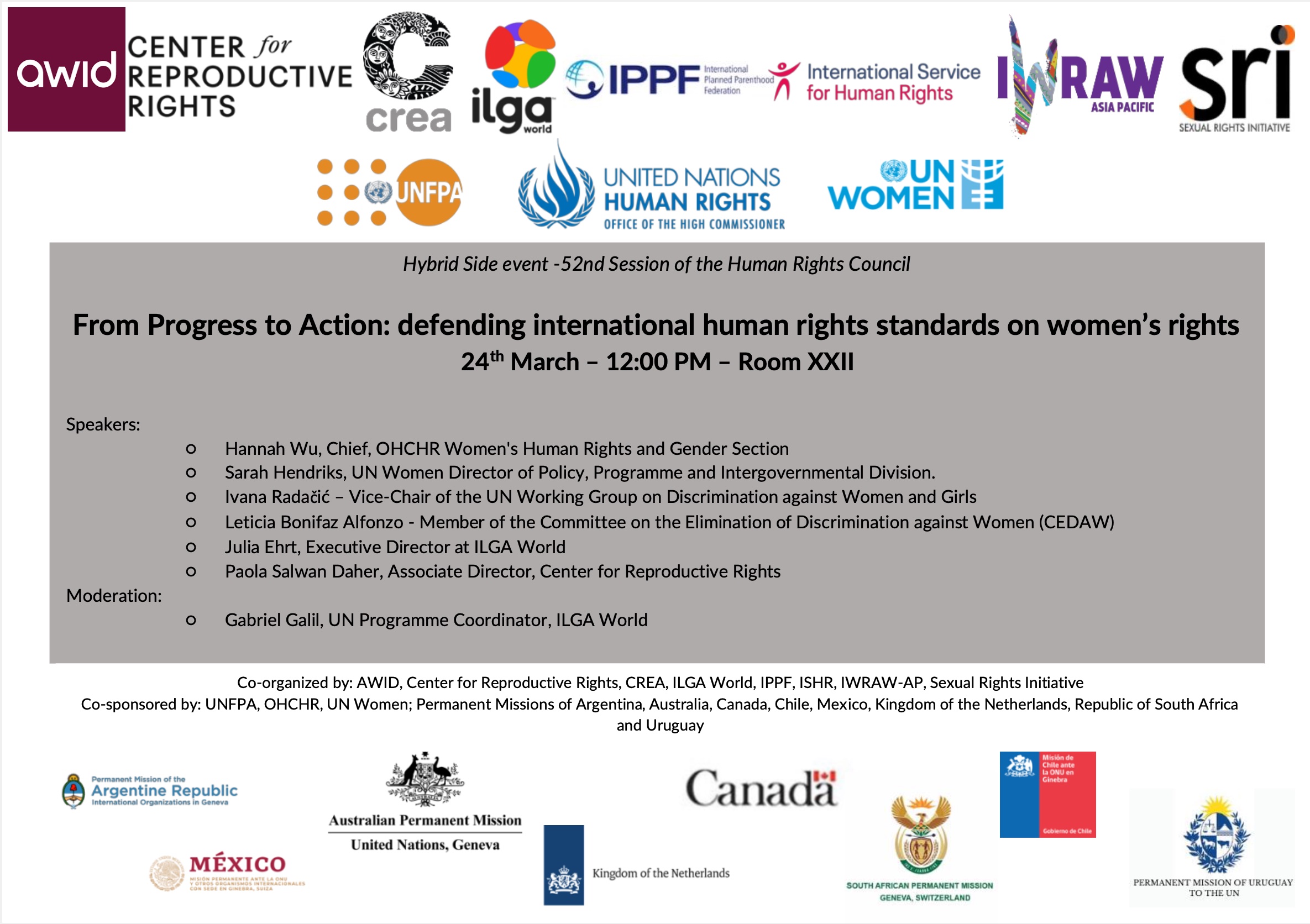
Co-organised by:
Association for Women’s Rights in Development (AWID), Center for Reproductive Rights ILGA World, CREA, International Planned Parenthood Federation (IPPD), International Service for Human Rights (ISHR), International Women’s Rights Action Watch Asia Pacific (IWRAW) and the Sexual Rights Initiative
Co-sponsored by:
the Permanent Missions of Argentina, Australia, Canada, Chile, Mexico, the Netherlands, South Africa, Uruguay, OHCHR and UNFPA, UN Women
Speakers:
Peggy Hicks, Director of the OHCHR Thematic Engagement, Special Proceduresindependent human rights experts within the UN Human Rights Council with mandates to report and advise on human rights from a thematic or country-specific perspective. They are non-paid and elected for 3-year mandates that can be re-conducted for another three years. Special procedures can undertake country visits, and act on individual cases of reported violations by sending communications to States and others. They also engage in advocacy, raise public awareness, provide advice for technical cooperation, and contribute to the development of international human rights standards.
More and Right to Development Division
Ivana Radačić, Member from the UN Working Group on Discrimination against Women and Girls
Ms Leticia Bonifaz Alfonzo, CEDAW Member
Julia Ehrt, Executive Director at ILGA World
Sonia Correa, researcher and activist
UN Women Representative (TBD)