
Summary
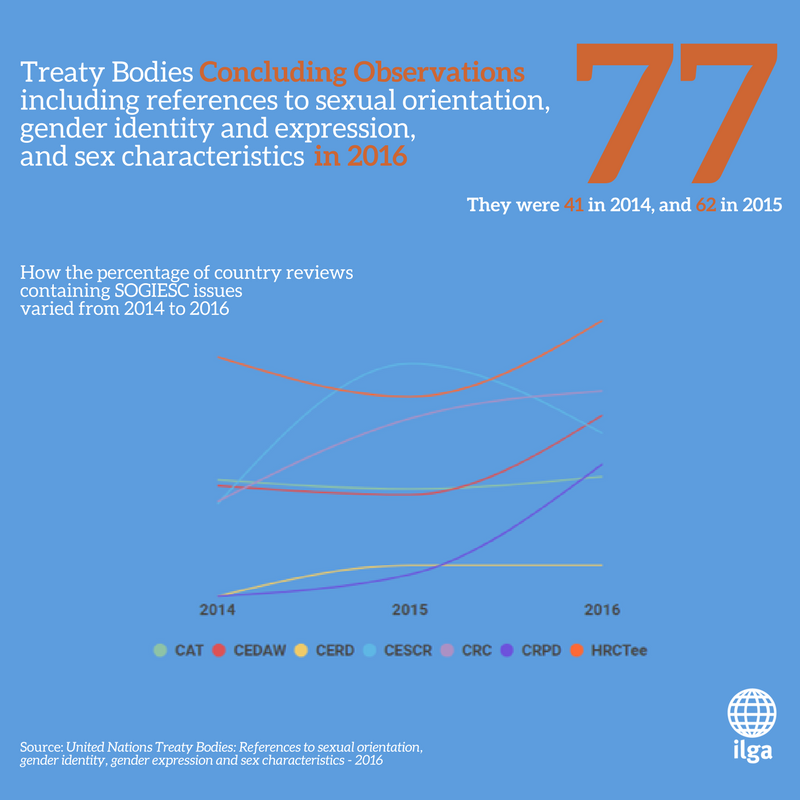
In 2016 alone, the United Nationsan international organisation comprising 193 member States. It has the mission of maintaining peace and security, protecting human rights, providing humanitarian aid and ensuring economic and social development across the globe. It is a network of many different bodies and agencies, each of which has a particular role and responsibility. More Treaty Bodies have issued 77 Concluding Observationsobservations and recommendations issued by a treaty body after it has considered a State party’s report and reports submitted by civil society organisations and had a dialogue with the State. More including references to sexual orientationrefers to a person’s capacity for profound emotional, affectional and sexual attraction to - and intimate and sexual relations with - individuals of a different gender or the same gender or more than one gender. More, gender identityrefers to a person’s deeply felt internal and individual experience of gender, which may or may not correspond with the sex assigned at birth. More and expression, and sex characteristicsa term that refers to physical features relating to sex - including genitalia and other sexual and reproductive anatomy, chromosomes, hormones, and secondary physical features emerging from puberty. More: that figure has almost doubled compared to 2014, when 41 recommendations were made. The percentage of country reviewsa process whereby UN treaty bodies review the implementation of specific treaties by State parties. After the ratification of a treaty, a State has to provide reports on its implementation periodically. Concluding Observations are the outcome of these reviews. More that contain such recommendations has also increased dramatically, moving from the 34% recorded in 2014 to 53% in 2016.
“These recommendations can be crucial foundations for LGBTIacronym for lesbian, gay, bisexual, trans and intersex people. Although this is not the acronym available to describe people of diverse sexual orientations, gender identities and expressions, and sex characteristics, it is the most commonly used in United Nations spaces and advocacy. More activists to advocate human rights for our communities,” explains Kseniya Kirichenko, who leads the Treaty Bodies and Special Proceduresindependent human rights experts within the UN Human Rights Council with mandates to report and advise on human rights from a thematic or country-specific perspective. They are non-paid and elected for 3-year mandates that can be re-conducted for another three years. Special procedures can undertake country visits, and act on individual cases of reported violations by sending communications to States and others. They also engage in advocacy, raise public awareness, provide advice for technical cooperation, and contribute to the development of international human rights standards.
More Programme at ILGA and authored The United Nations Treaty Bodies: References to sexual orientation, gender identity, gender expression and sex characteristics – 2016. “The importance of civil society in bringing about change can’t be overstated, as it continues to provide quality advocacy to encourage more specific recommendations, prompting human rights bodies to address violations against LGBTI persons and communities worldwide.”
Click here to download The United Nations Treaty Bodies: References to sexual orientation, genderrefers to a social construct which places cultural and social expectations on individuals based on their assigned sex. More identity, gender expressionrefers to how a person presents their gender through physical appearance – including dress, hairstyles, accessories, cosmetics – and mannerisms, speech, behavioural patterns, names and personal references. More and sexrefers to the classification of a person as male, female, or other - usually made at birth, written on a birth certificate, and usually based on the appearance of their external anatomy. A person’s sex, however, is actually a combination of bodily characteristics, including chromosomes, hormones, internal and external reproductive organs, and secondary sex characteristics. More characteristics – 2016
The Treaty Bodies are independent committees that monitor State compliance with international human rights lawa legal system laying down obligations which States are bound to respect. By becoming parties to international treaties, States assume obligations and duties under international law to respect, protect and fulfil human rights – including by putting into place domestic measures and legislation. Where domestic legal proceedings fail to address human rights abuses, mechanisms and procedures for individual complaints or communications are available at the regional and international levels to help ensure that international human rights standards are respected. More treaties. Since May 2015, ILGA has implemented a programme to assist LGBTI civil society as it engages with these bodies, gaining insight into the approach of the seven committees most relevant to LGBTI and gender non-conforming persons.
ILGA’s The United Nations Treaty Bodies: References to sexual orientation, gender identity, gender expression and sex characteristics stems from our daily engagement with these human rights bodies, providing a comprehensive annual compilation and analysis of all the SOGIESCabbreviation standing for sexual orientation and gender identity & expression, and sex characteristics. More references they made in 2016.
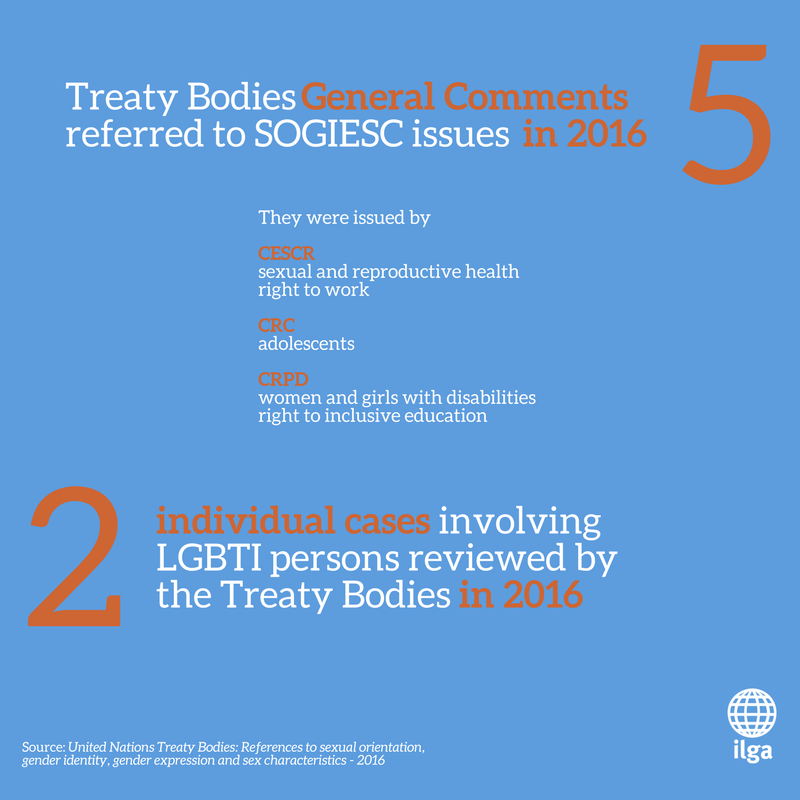
“Throughout the year, the Committees have showed promising progress especially in how they addressed ‘conversion’ therapy, family diversity, hate speechany kind of communication in speech, writing or behaviour that attacks or uses
pejorative or discriminatory language with reference to a person or a group on the basis of who
they are – including on the grounds of their gender, sexual orientation, gender identity and
expression, or sex characteristics amongst others. More and hate crimes, as well as sex characteristics, gender identity, and intersections between SOGIESC and disability,” further explains Kirichenko. “Such developments prove that positive shifts are achievable at least at the UN level, and under-represented populations can be recognized and heard in this space.”
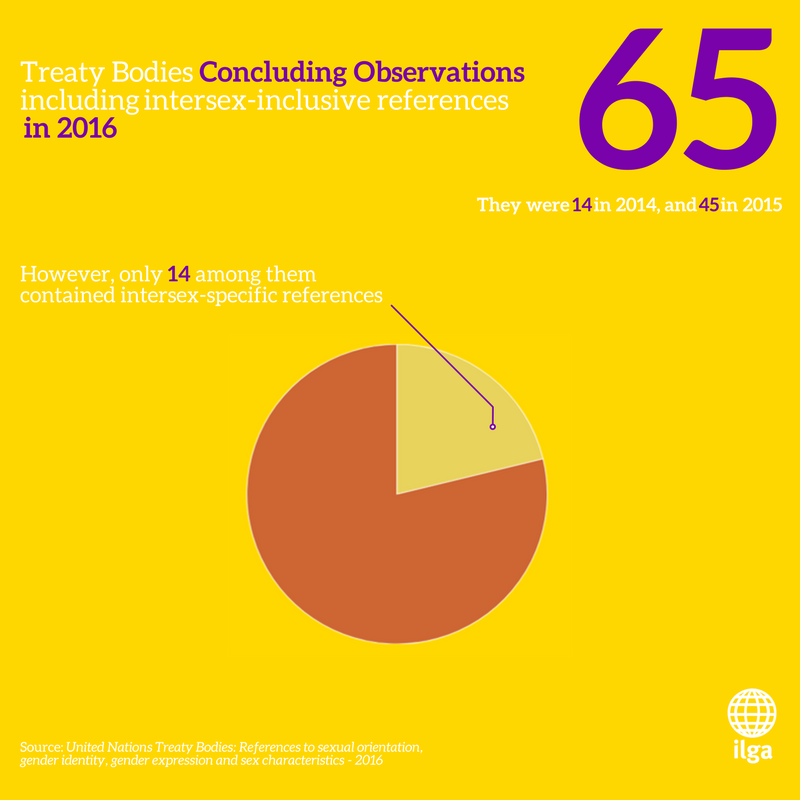
This progress, however, does not come without challenges. While 65 intersex-inclusive references were made in 2016, showing a constant increase since the 14 issued in 2014, most of them were folded into the LGBTI acronym, and only a small part of them were intersex-specific – an inclusion that may end up making the specific needs of intersexan umbrella term for the spectrum of variations of sex characteristics that naturally occur within the human species. Intersex people are born with variations of sex characteristics (such as genitals, reproductive organs, hormonal and chromosomal patterns) that are more diverse than stereotypical definitions of male or female bodies. Up to 1.7% of the global population are born with such traits; yet, because their bodies are seen as different, intersex children and adults are often stigmatised and subject to harmful practices – including in medical settings - and discriminated against. More populations invisible.
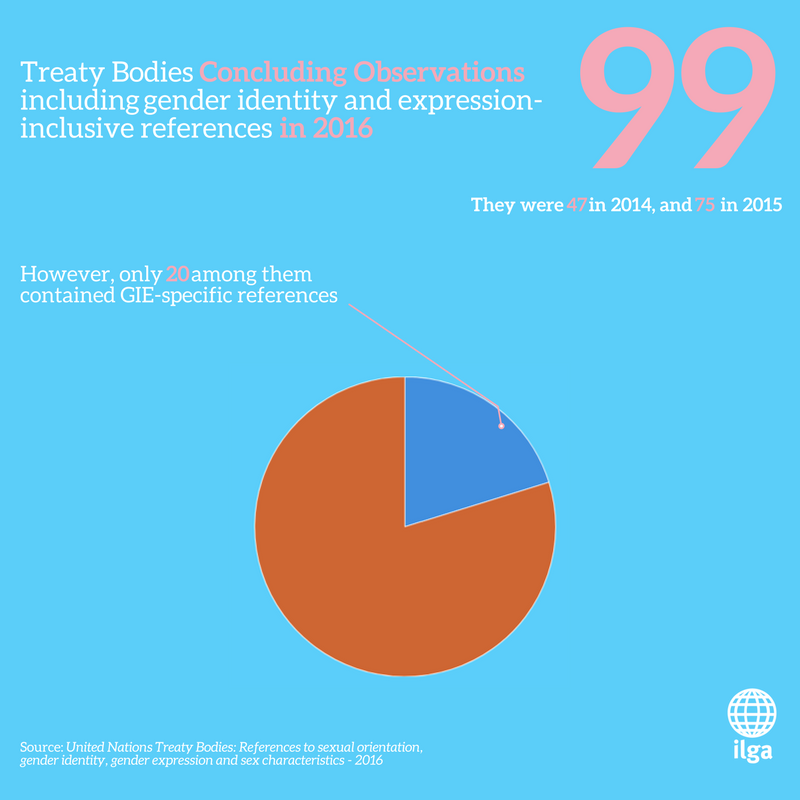
Despite huge step forwards, similar concerns are also present when considering how gender identity and gender expression issues are addressed within the Treaty Bodies: only 20 of the 99 recommendations issued on these matters in 2016 were trans-specific, mainly focusing on legal gender recognitionlaws, administrative procedures or processes by which a person can change their sex/gender marker and names on official identity documents. More and violence while often leaving other topics – such as discriminationunequal or unfair treatment which can be based on a range of grounds - such as age, ethnic background, disability, and diverse sexual orientations, gender identities and expressions or sex characteristics, amongst others. More, socio-economic status or access to specific health services – out of the agenda.
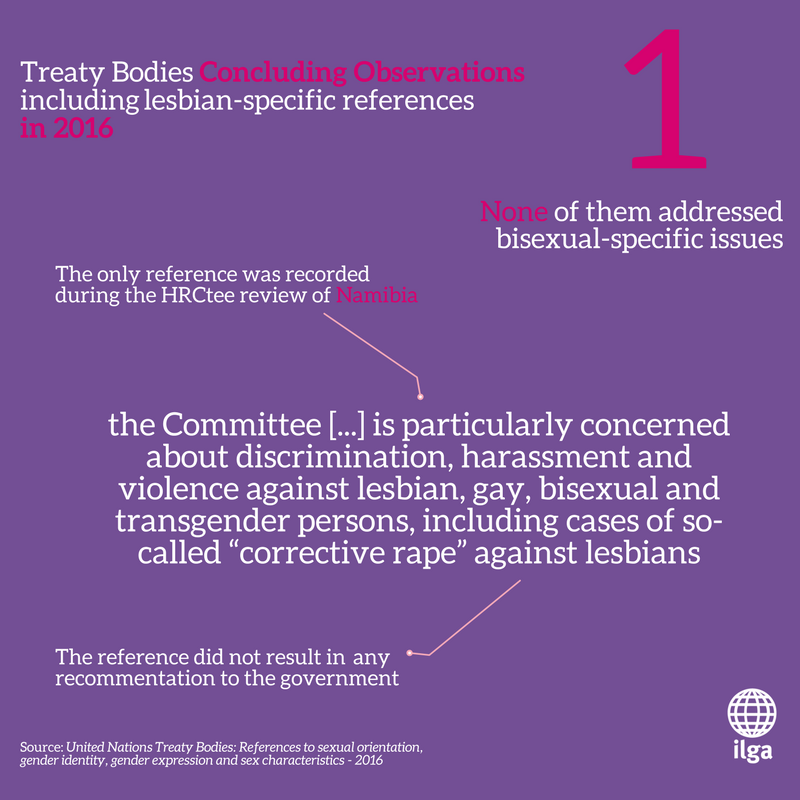
And even more challenging appears to be particular problems faced by lesbianadjective/noun to describe a woman whose enduring physical, romantic, and/or emotional attraction is to other women. Women and non-binary people may use this term to describe themselves. More and bisexualadjective used to describe a person who has the capacity to form enduring physical, romantic, and/ or emotional attractions to those of the same gender or to those of other genders. More women. Out of all SOGIESC references made by the UN committees in 2016, there was only one stand-alone sentence addressing “corrective rapes” towards lesbian women in Namibia.
“Our study on SOGIESC-related work of the UN Treaty Bodies shows how exciting, promising and effective, but also sometimes unpredictable and discouraging, engaging with the committees can be,” commented Ruth Baldacchino and Helen Kennedy, co-secretaries general of ILGA. “The progress documented here is definitely encouraging, but we know that it will only be meaningful to the lives of LGBTI people if the committees’ recommendations are actually implemented: and grassroots activists must be equipped with the resources and skills to do so. We hope that our research will be a useful and empowering tool as they engage with these UN mechanisms.”