Summary
The resolution was adopted by a vote of 27 in favour, with 12 voting against and 7 abstentions.
The campaign calling on the Council to renew the mandate of the UN Independent Expert on SOGIabbreviation standing for sexual orientation and gender identity More was supported by 1,312 non-governmental organizations from 174 States and territories.
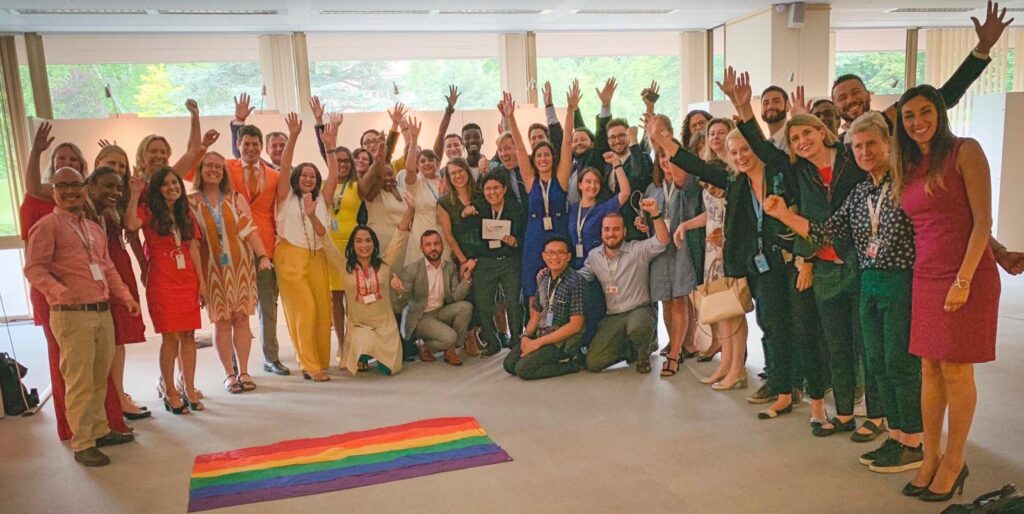
“This is another historic victory, not only for communities of diverse sexual orientations and genderrefers to a social construct which places cultural and social expectations on individuals based on their assigned sex. More identities, but for humanity as a whole”, said Paula Sebastiao of Arquivo de Identidade Angolano in Angola and Simran Shaikh, Asia coordinator of the Transadjective/umbrella term to describe a person whose gender identity does not match the sex they were assigned at birth. More Respect v. Transphobiarefers to negative cultural and personal beliefs, opinions, attitudes and behaviours based on prejudice, disgust, fear and/or hatred of trans people or against variations of gender identity and gender expression. More project, on behalf of 63 human rights groups worldwide. “Following the call from a record number of organizations from every region imaginable, the UN Human Rights Councilan inter-governmental body within the United Nations which has the responsibility to promote and protect human rights. It is comprised of 47 member States, each elected to 3-year terms by the 193 member States of the United Nations. More has reaffirmed its commitment to combat discriminationunequal or unfair treatment which can be based on a range of grounds - such as age, ethnic background, disability, and diverse sexual orientations, gender identities and expressions or sex characteristics, amongst others. More and violence on grounds of SOGI and has reminded all states of their obligations towards these communities.”
Created in 2016, the UN Independent Expert on SOGI has been supported by an ever-growing number of States from all regions of the world. The resolution to create and renew the mandate was presented by a Core Group of seven Latin American countries – Argentina, Brazil, Chile, Colombia, Costa Rica, Mexico, and Uruguay.
“The renewal of this mandate demonstrates how United Nationsan international organisation comprising 193 member States. It has the mission of maintaining peace and security, protecting human rights, providing humanitarian aid and ensuring economic and social development across the globe. It is a network of many different bodies and agencies, each of which has a particular role and responsibility. More States’ support for tackling violence and discrimination against people of diverse sexual orientations and gender identities has grown tremendously,” said UN Trans Advocacy Week campaigners. “The Independent Expert is crucial in bringing international attention to specific violations and challenges faced by trans and gender-diverse persons in all regions.”
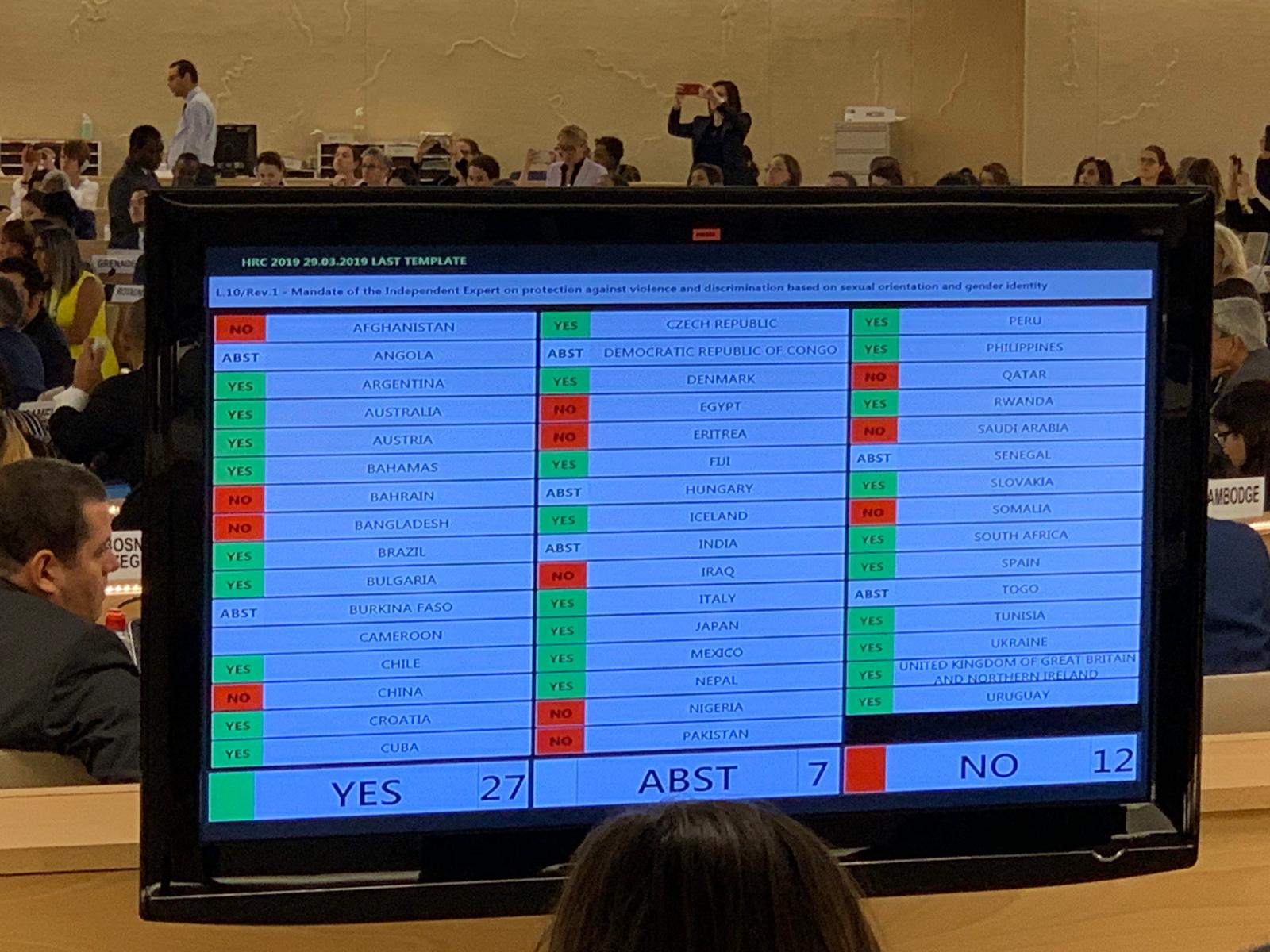
The results of the vote confirming the renewal of the mandate
Although the renewal process had to overcome 10 hostile amendments, the core of the resolution in affirming the universal nature of international human rights lawa legal system laying down obligations which States are bound to respect. By becoming parties to international treaties, States assume obligations and duties under international law to respect, protect and fulfil human rights – including by putting into place domestic measures and legislation. Where domestic legal proceedings fail to address human rights abuses, mechanisms and procedures for individual complaints or communications are available at the regional and international levels to help ensure that international human rights standards are respected. More stands firm.
“The existence of a specific UN human rights mechanism looking at SOGI issues is crucial for our communities to be heard at the global level,” added Ryan Silverio of ASEAN SOGIEabbreviation standing for sexual orientation, gender identity and expression. More Caucus from the Philippines. “If the world is truly committed to leaving no one behind, it can’t shy away from addressing the violence and discrimination that we face. Laws criminalising our identities and actions are unjust and should no longer be tolerated”.
The UN Independent Expert on SOGI is tasked with assessing implementation of existing international human rights law, by talking to States, and working collaboratively with other UN and regional mechanisms to address violence and discrimination. Through the work of this mandate since 2016, the impact of criminalisation of same-sex relations and lack of legal gender recognitionlaws, administrative procedures or processes by which a person can change their sex/gender marker and names on official identity documents. More, the importance of data-collection specific to SOGI communities, and examples of good practices to prevent discrimination have been highlighted globally, with visits to Argentina, Georgia, Mozambique and Ukraine.
“The extraordinary work of hundreds of human rights defenders and grassroots organisations from all over the world is what made today’s historic result possible”, said Tuisina Ymania Brown and Luz Elena Aranda, co-Secretaries General at ILGA World. “Their continuous push for change prompted 55 states to support the renewal of the mandate and send a clear message that the Human Rights Council will support protections against violence and discrimination based on sexual orientation and gender identity”.
We hope that all governments cooperate fully with the UN Independent Expert on SOGI in this important work to bring about a world free from violence and discrimination for all people regardless of sexual orientation and gender identity.
Organisations signing the statement:
42 Degrees
ABGLT – ASSOCIAÇÃO BRASILEIRA DE LESBICAS, GAYS, BISSEXUAIS, TRAVESTIS, TRANSEXUAIS E INTERSEXOS
Accountability International
Amnesty International
ARC International
ASEAN SOGIE Caucus
Asia Pacific Transgender Network (APTN)
Asistencia Legal por los Derechos Humanos A.C. (ASILEGAL)
Asociación OTD Chile
Caribe Afirmativo
çavaria
Centro de Promoción y Defensa de los Derechos Sexuales y Reproductivos – Promsex
CHOICE for Youth and Sexuality
COC Nederland
Colectivo Alejandria
Comunidad Homosexual Argentina (CHA)
Conurbanes por la Diversidad
Egale Canada
Equality Australia
ERA – LGBTIacronym for lesbian, gay, bisexual, trans and intersex people. Although this is not the acronym available to describe people of diverse sexual orientations, gender identities and expressions, and sex characteristics, it is the most commonly used in United Nations spaces and advocacy. More Equal Rights Association for Western Balkans and Turkey
Fundación Afrodescendiente por las Diversiades Sociales y Sexuales – SOMOS IDENTIDAD
Fundacion Arcoiris por el respeto a la diversidad sexual
Fundación Reflejos de Venezuela
GATE
Gender DynamiX
GIN-SSOGIE
Haus of Khameleon
Helsinki Committee for Human Rights of the Republic of Macedonia
Human Rights Awareness and Promotion Forum
Human Rights Law Centre
IGLYO
ILGA Asia
ILGA World
ILGALAC – Asociación Internacional de Lesbianas, Gays, Bisexuales, Trans e Intersexan umbrella term for the spectrum of variations of sex characteristics that naturally occur within the human species. Intersex people are born with variations of sex characteristics (such as genitals, reproductive organs, hormonal and chromosomal patterns) that are more diverse than stereotypical definitions of male or female bodies. Up to 1.7% of the global population are born with such traits; yet, because their bodies are seen as different, intersex children and adults are often stigmatised and subject to harmful practices – including in medical settings - and discriminated against. More para América Latina y El Caribe
International Family Equality Day
International Bar Association’s Human Rights Institute (IBAHRI)
International Service for Human Rights
Iranti
Korean Lawyers for Public Interest and Human Rights (KLPH)
Las Reinas Chulas Cabaret y Derechos Humanos AC
LGBTI Support Center
LSVD Lesbianadjective/noun to describe a woman whose enduring physical, romantic, and/or emotional attraction is to other women. Women and non-binary people may use this term to describe themselves. More and Gayadjective to describe people whose enduring physical, romantic, and/ or emotional
attractions are to people of the same gender. Men, women and non-binary people may use this
term to describe themselves. More Federation in Germany
Namibia Diverse Women’s Association (NDWA)
ODRI Intersectional rights
OutRight Action International
Pacific Human Rights Initiative
People’s Matrix
People’s Solidarity for Participatory Democracy
Planet Allya term used to describe someone who is actively supportive of LGBTI people. It encompasses straight and cisgender allies, as well as LGBTI people who actively support other populations within the community at large. More
Red Latinoamericana GayLatino
REDTRANS Nicaragua
RFSL, the Swedish Federation for LGBTQ Rights
RFSU
RWS – India’s Diverse Chamber
Stichting NNID
Synergía – Initiatives for Human Rights
The International Institute on Race, Equality and Human Rights
the Transgender Liberation Front(abbr. TLF)
Trans Pasefika
TransAction (Aotearoa / New Zealand)
Transgender Europe (TGEU)
Valientes de Corazón Ecuador
Young Queerpreviously used as a derogatory term to refer to LGBT individuals in the English language – and still perceived as offensive by some - queer has been reclaimed by people who identify beyond traditional gender categories and heteronormative social norms. Although not universally accepted, it is often used as a catch-all to include many people within the larger community of people with diverse sexual orientations, gender identities and expressions, and sex characteristics. More Alliance