From 11 to 22 March 2024, the United Nations (UN) Independent Expert on the enjoyment of all human rights by older persons, Dr Claudia Mahler, conducted an official visit to Peru to assess the human rights situation of older persons in the country. During the visit, LGBTIacronym for lesbian, gay, bisexual, trans and intersex people. Although this is not the acronym available to describe people of diverse sexual orientations, gender identities and expressions, and sex characteristics, it is the most commonly used in United Nations spaces and advocacy. More groups engaged with the UN Independent Expert to raise the specific issues faced by older LGBTI persons, particularly their exclusion from public policies and lack of special protection.
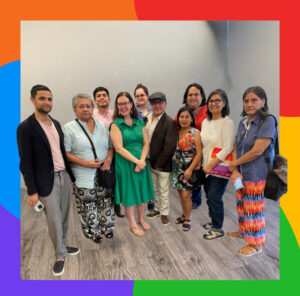
A photo with the UN Independent Expert on Older Persons, Ms Claudia Mahler, and LGBTI activists in the ILGA World photo frame.
With the support of ILGA World, Centro de Promoción y Defensa de los Derechos Sexuales y Reproductivos (Promsex), Comunidad Homosexual Esperanza Región Loreto (CHERL), Lesbianas Independientes Feministas Socialistas (LIFS), Más Igualdad Perú, and Movimiento Homosexual de Lima (MHOL) participated in three meetings with the Independent Expert in Lima, Ayacucho and Iquitos. Based on a more extensive online consultation with the activists, ILGA World also submitted written input to the mandate in English and Spanish on the situation of older LGBTI persons in the country.
Our Consultant on UN Treaty Bodies, Andrea Baldwin, supported the activists and attended the meetings in person, while our Senior Programme Officer on UN Special Proceduresindependent human rights experts within the UN Human Rights Council with mandates to report and advise on human rights from a thematic or country-specific perspective. They are non-paid and elected for 3-year mandates that can be re-conducted for another three years. Special procedures can undertake country visits, and act on individual cases of reported violations by sending communications to States and others. They also engage in advocacy, raise public awareness, provide advice for technical cooperation, and contribute to the development of international human rights standards.
More and SDGs, Guillermo Ricalde, and Junior Consultant on UN Special Procedures and SDGs, Venus Aves, facilitated their engagement with the UN Independent Expert.
Multiple vulnerabilities of older LGBTI persons
During the meeting, the activists discussed how older LGBTI persons encounter unique barriers to the full enjoyment of their human rights due to their age, as well as their sexual orientationrefers to a person’s capacity for profound emotional, affectional and sexual attraction to - and intimate and sexual relations with - individuals of a different gender or the same gender or more than one gender. More, gender identityrefers to a person’s deeply felt internal and individual experience of gender, which may or may not correspond with the sex assigned at birth. More and expression and sex characteristicsa term that refers to physical features relating to sex - including genitalia and other sexual and reproductive anatomy, chromosomes, hormones, and secondary physical features emerging from puberty. More (SOGIESCabbreviation standing for sexual orientation and gender identity & expression, and sex characteristics. More), including:
- Insufficient legal protection, especially for those further marginalized by other identities such as migrant or refugee status.
- Limited to no access to healthcare, housing, employment and social security, including adequate retirement, and the denial of the right to a dignified death.
- Economic insecurity and lack of state-supported system of care and support.
- Non-recognition of same-sex partnerships, and difficulties in accessing legal gender recognitionlaws, administrative procedures or processes by which a person can change their sex/gender marker and names on official identity documents. More.
As part of her preliminary findings, the Independent Expert recommends establishing dedicated care centers to address the particular vulnerabilities of older LGBTI persons, and collecting data disaggregated by sexual orientation and genderrefers to a social construct which places cultural and social expectations on individuals based on their assigned sex. More identity to effectively respond to their issues through evidence-based public policy.
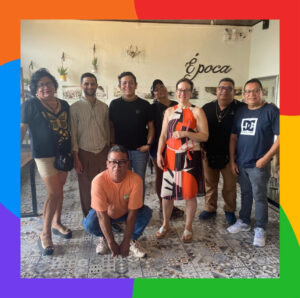
A photo of activists and the UN Independent Expert on Older Persons, Claudia Mahler, gathered together in the ILGA World photo frame.
While the UN Independent Expert has already highlighted the “heightened risk of violence and discrimination”that older LGBTI persons face in 2023, after her engagement with LGBTI activists in Peru, she also raised alarm on several issues, including:
- Discriminationunequal or unfair treatment which can be based on a range of grounds - such as age, ethnic background, disability, and diverse sexual orientations, gender identities and expressions or sex characteristics, amongst others. More in healthcare settings, including misgendering and stigma related to HIV.
- Lack of access to gender-affirming care, including hormone therapy.
- Rejection by family members.
- Discrimination in care centers.
- Lack of protection and abuse in prison settings, exacerbated by policies housing transadjective/umbrella term to describe a person whose gender identity does not match the sex they were assigned at birth. More people based on their assigned sexrefers to the classification of a person as male, female, or other - usually made at birth, written on a birth certificate, and usually based on the appearance of their external anatomy. A person’s sex, however, is actually a combination of bodily characteristics, including chromosomes, hormones, internal and external reproductive organs, and secondary sex characteristics. More at birth.
During the visit, LGBTI groups engaged with the UN Independent Expert to raise the specific issues faced by older LGBTI persons, particularly their exclusion from public policies and lack of special protection.