- The UN Independent Expert on SOGI’s first-ever report on violence and discriminationunequal or unfair treatment which can be based on a range of grounds - such as age, ethnic background, disability, and diverse sexual orientations, gender identities and expressions or sex characteristics, amongst others. More against LBQ women marked a historic milestone in advancing genderrefers to a social construct which places cultural and social expectations on individuals based on their assigned sex. More justice and LGBTIacronym for lesbian, gay, bisexual, trans and intersex people. Although this is not the acronym available to describe people of diverse sexual orientations, gender identities and expressions, and sex characteristics, it is the most commonly used in United Nations spaces and advocacy. More rights.
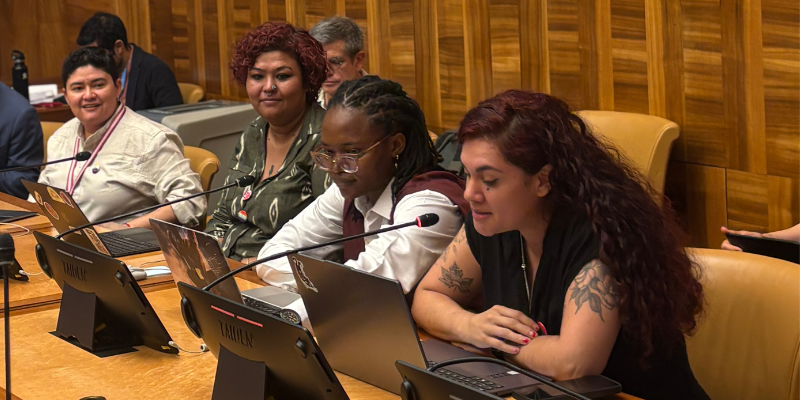
- ILGA World, together with Outright International and RFSL, hosted the inaugural LBQ Women’s Advocacy Week, creating a dedicated space for activists to engage directly with UN stakeholders and decision-makers.
- Building on years of advocacy, ILGA World is working with members and partners to turn the report’s recommendations into lasting legal, policy and social change for LBQ women worldwide.
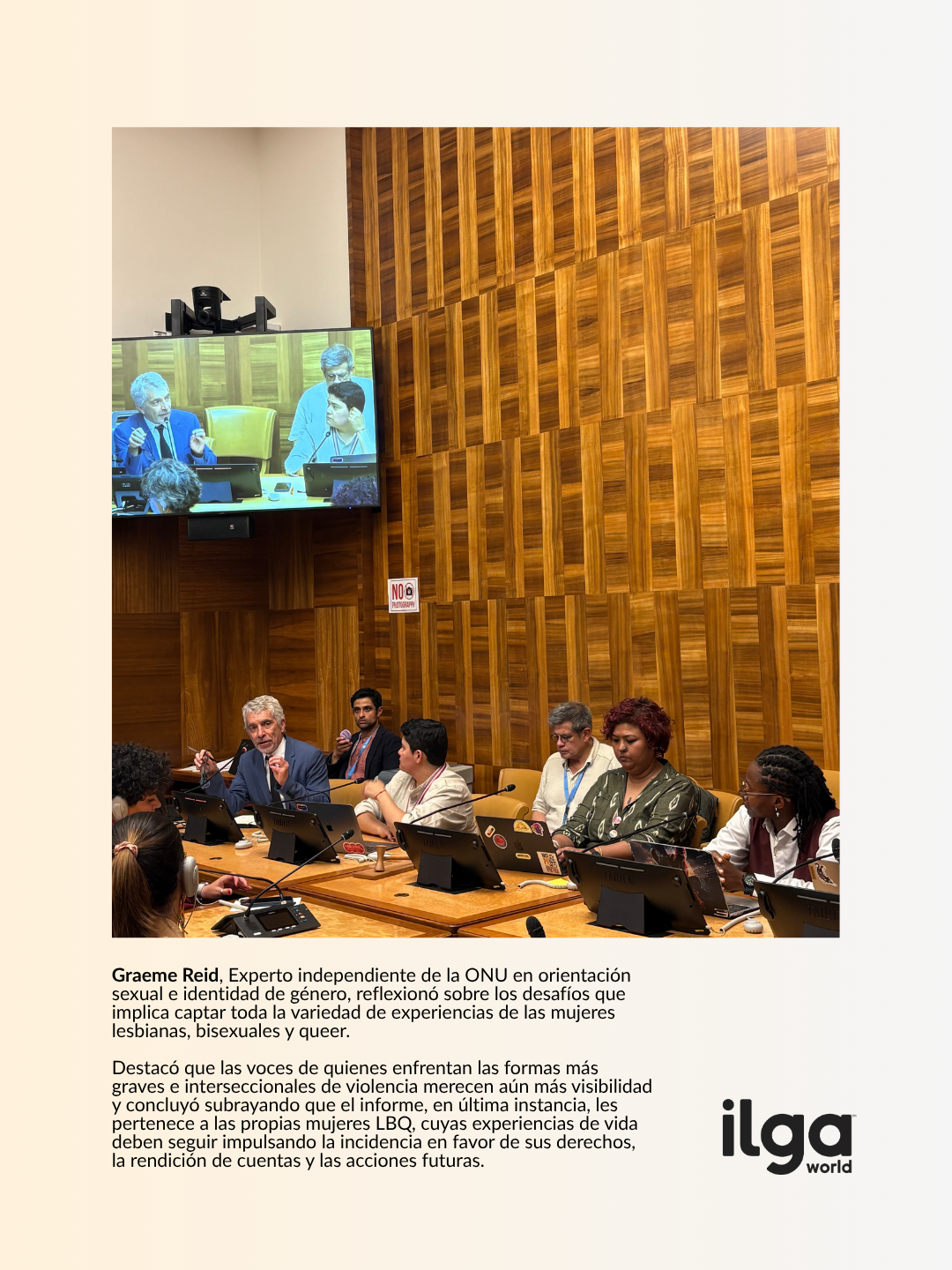
“Women reported violence by family members, including forced marriage, confinement, surveillance and sexual violence, often intended to punish or alter their sexual orientationrefers to a person’s capacity for profound emotional, affectional and sexual attraction to - and intimate and sexual relations with - individuals of a different gender or the same gender or more than one gender. More. So-called “corrective” violence continues to be reported.
These acts should not be understood as isolated incidents. They function as regulatory practices, enforcing conformity with gender norms and punishing those who depart from them.”
Statement by Mr Graeme Reid (IE SOGIabbreviation standing for sexual orientation and gender identity More), 62nd session of the Human Rights Councilan inter-governmental body within the United Nations which has the responsibility to promote and protect human rights. It is comprised of 47 member States, each elected to 3-year terms by the 193 member States of the United Nations. More, agenda item 3, 18 June 2026, Geneva
A milestone in the progress of women’s rights and gender justice was the release of the inaugural report of its kind, titled ‘Violence and Discrimination Experienced by Lesbian, Bisexual, and Queer Women.’ The report was presented by Graeme Reid, the Independent Expert on Protection Against Violence and Discrimination Based on Sexual Orientation and Gender Identity (IE SOGI), during the 62nd session of the Human Rights Council, held from 15 June to 10 July 2026.
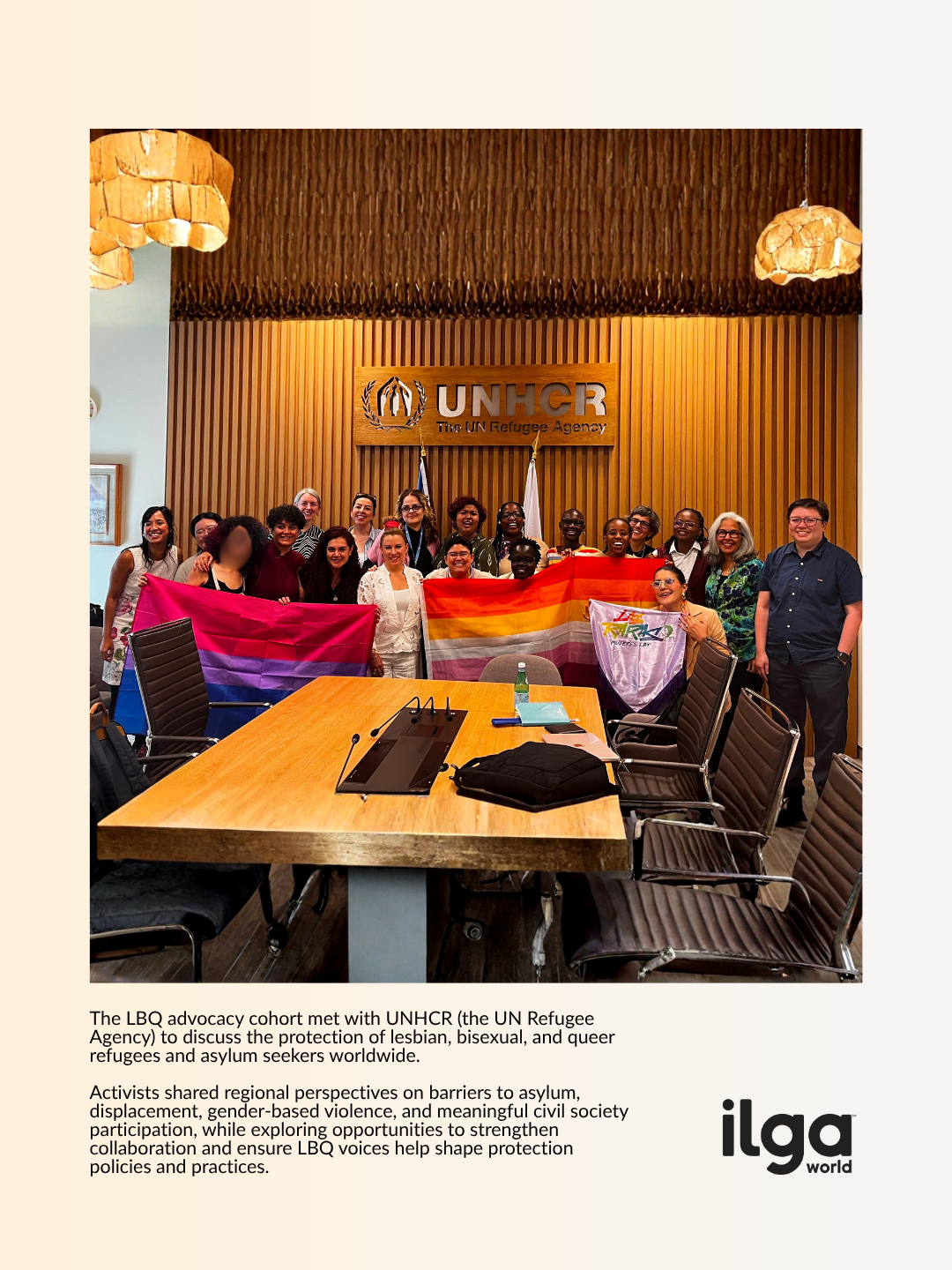
In conjunction with this significant milestone, ILGA World, together with Outright International and RFSL, hosted the first-ever LBQ Women’s Advocacy Week, held from 14th to 20th June 2026, alongside the 2026 Trans Advocacy Week. The LBQ women’s advocacy week successfully brought together 11 Human Rights Defenders and activists from across the five regions, namely Africa, Asia, Europe and Latin America and the Caribbean, to engage directly with UN member states, permanent missions, mandate holders, and other allies, including CSOs and multilateral agencies.
Together with its LBQ women’s advocacy week partners, ILGA World worked strategically to create a dedicated and visible space for lesbianadjective/noun to describe a woman whose enduring physical, romantic, and/or emotional attraction is to other women. Women and non-binary people may use this term to describe themselves. More bisexualadjective used to describe a person who has the capacity to form enduring physical, romantic, and/ or emotional attractions to those of the same gender or to those of other genders. More and queerpreviously used as a derogatory term to refer to LGBT individuals in the English language – and still perceived as offensive by some - queer has been reclaimed by people who identify beyond traditional gender categories and heteronormative social norms. Although not universally accepted, it is often used as a catch-all to include many people within the larger community of people with diverse sexual orientations, gender identities and expressions, and sex characteristics. More women within multilateral human rights processes. The week highlighted a long-standing gap in international advocacy which prioritises lesbian bisexual and queer women’s experiences falling between mainstream gender equality efforts and broader LGBTI advocacy. By bringing these experiences to the forefront, the partnership ensured that LBQ women are recognised as central to the global human rights agenda, paving the way for more inclusive policies, stronger protections, and meaningful progress towards gender justice.
To arrive here, ILGA World has, over the years, actively engaged with a range of UN Special Procedures mandate holders and multilateral spaces to foster openness to sexual orientation, gender identity and expression and sexual characteristic issues. There has also been extensive use of the Universal Periodic Review and Treaty Bodies to ensure more LBQ-, intersex- and trans-inclusive recommendations. In this regard, over 2025-2026, the advocacy team supported the engagement of Colombian lesbian, bisexual, queer, trans, and non-binary members during the IESOGI visit to Colombia and contributed to efforts to organise a town hall meeting with the mandate alongside RFSL and LESLAC. These efforts served as the precedent for the thematic report focusing on LBQ women. The team within ILGA World has worked intensively with our members to gather their input for this IE SOGI-led report.
One such effort was a submission authored by ILGA World alongside 6 member organisations. The submission emphasised multiple points which were reflected in the final report as well; some of these were around forced invisibilities of LBQ women, patterns of violence, workplace discrimination, and data gaps, among others.
ILGA World specifically supported activists and Human Rights Defenders from Colombia, Peru, South Korea and Zimbabwe. Alex Hernandez Muro, Executive Director of Más Igualdad Perú and Regional Counsellor for the Andean Region at the ILGA Latin America and the Caribbean region (ILGA LAC), shared their reflections about this historic week:
The LBQ Advocacy Week was a meaningful reminder of why visibility matters. As a bisexual person, participating in the side event allowed me to highlight experiences that are often rendered invisible or subsumed under broader identities. Yet bisexual people face specific challenges of our own, and mental health data repeatedly shows the consequences of stigma, erasure, and the absence of community. It is crucial that when we talk about LBQ experiences, we recognise the full diversity and complexity of our communities, rather than focusing on a single dimension of our shared struggles and identities.
I am deeply grateful for the opportunity to have been part of this space and to bring a distinct perspective to the discussion. It was also incredibly enriching to connect with LBQ activists from around the world who are advancing this work with courage and commitment. Their leadership was both inspiring and energising, and it reminded me that our collective strength lies in our solidarity. Together, we can achieve far more than any of us can alone. I especially welcome the report’s commitment to centring women’s experiences in all their diversity and ensuring that no part of our community is left unseen.
The way forward
The journey to this point has not been easy, and achieving visibility in multilateral advocacy spaces has been an uphill climb. Now it is critical to move from visibility to implementation, with the report serving as a roadmap. As next steps, some of the immediate steps we plan to adopt are:
- Advancing engagement with UN human rights mechanisms, including the Working Group on Discrimination against Women and Girls, the Working Group on Business and Human Rights, the Special Rapporteur on Extreme Poverty and Human Rights, UN Women and other mandate holders and UN agencies, to ensure lesbian bisexual and queer women’ perspectives are integrated across their work.
- Strengthening economic justice advocacy by developing a dedicated strategy on the economic rights of LBQ women, including engagement with the UN Forum on Business and Human Rights on issues such as workplace inclusion, human rights due diligence and the “lesbianization of poverty.”
- Supporting the implementation of the IE SOGI’s recommendations by contributing to upcoming thematic consultations, future Special Proceduresindependent human rights experts within the UN Human Rights Council with mandates to report and advise on human rights from a thematic or country-specific perspective. They are non-paid and elected for 3-year mandates that can be re-conducted for another three years. Special procedures can undertake country visits, and act on individual cases of reported violations by sending communications to States and others. They also engage in advocacy, raise public awareness, provide advice for technical cooperation, and contribute to the development of international human rights standards.
More reports and relevant OHCHR guidance processes, while continuing to facilitate the meaningful participation of LBQ activists in these spaces. - Sustaining the global LBQ advocacy network created during the week by supporting continued exchanges between activists, documenting good practices, and creating new opportunities alongside partners (Outright International and RFSL) for collective advocacy beyond Geneva.
Ultimately, ILGA World sees this report not simply as a milestone in international recognition, but as a practical roadmap for advancing the rights of LBQ women. Together with our members and partners, we remain committed to ensuring that its findings lead to lasting legal, policy and social change.