Summary
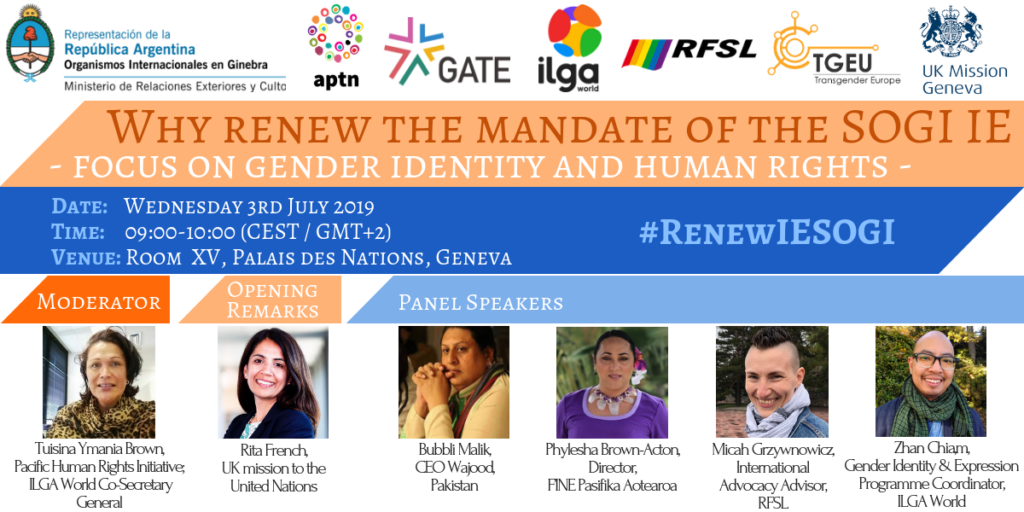
- Wednesday, 3rd July, 2019
- 9:00-10:00 CET/GMT+1 Palais des Nations, Room XV
Organizers:
Asia Pacific Transgender Network; GATE; ILGA World; RFSL – Swedish Federation for Lesbianadjective/noun to describe a woman whose enduring physical, romantic, and/or emotional attraction is to other women. Women and non-binary people may use this term to describe themselves. More, Gayadjective to describe people whose enduring physical, romantic, and/ or emotional
attractions are to people of the same gender. Men, women and non-binary people may use this
term to describe themselves. More, Bisexualadjective used to describe a person who has the capacity to form enduring physical, romantic, and/ or emotional attractions to those of the same gender or to those of other genders. More, Transadjective/umbrella term to describe a person whose gender identity does not match the sex they were assigned at birth. More and Queerpreviously used as a derogatory term to refer to LGBT individuals in the English language – and still perceived as offensive by some - queer has been reclaimed by people who identify beyond traditional gender categories and heteronormative social norms. Although not universally accepted, it is often used as a catch-all to include many people within the larger community of people with diverse sexual orientations, gender identities and expressions, and sex characteristics. More Rights; Transgender Europe
Co-sponsors:
Speakers:
Bubbli Malik, CEO Wajood, Pakistan
Phylesha Brown-Acton, Director, F’INE Pasifika Aotearoa
Micah Grzywnowicz, International Advocacy Advisor RFSL
Zhan Chiam, Gender Identityrefers to a person’s deeply felt internal and individual experience of gender, which may or may not correspond with the sex assigned at birth. More and Expression Programme Coordinator ILGA World
Opening remarks:
Julian Braithwaite, UK mission to the United Nationsan international organisation comprising 193 member States. It has the mission of maintaining peace and security, protecting human rights, providing humanitarian aid and ensuring economic and social development across the globe. It is a network of many different bodies and agencies, each of which has a particular role and responsibility. More
Moderator:
Tuisina Ymania Brown, Pacific Human Rights Initiative and ILGA World Co-Secretary General
Genderrefers to a social construct which places cultural and social expectations on individuals based on their assigned sex. More identity has become a key concept within the international human rights framework. It has been increasingly adopted by Treaty Bodies, Especial Procedures and UN agencies (including, for example, UNAIDS, WHO, UNHCR, etc.). As clearly demonstrated by the Yogyakarta Principles and the Yogyakarta Principles Plus Ten, gender identity issues can be addressed from many different angles – from the right to be recognized before the law to the right to health, from the right to education to the right to water and sanitation.
In spite of the generalized inclusion of gender identity in human rights language, many people around the world are still severely impacted by human rights violations based on their gender identity -in particular, trans and gender diverse people.
This side event will address gender identity issues in the context of the mandate of the Independent Expert on sexual orientation and gender identityabbreviated form to refer to the IESOGI – a UN Special Procedures mandate specifically dedicated to addressing violence and discrimination based on sexual orientation and gender identity. More (SOGIabbreviation standing for sexual orientation and gender identity More), highlighting advances made since the start of the mandate to date, as well as issues to be addressed in the future – including transphobic violence, socioeconomic justice, legal gender recognitionlaws, administrative procedures or processes by which a person can change their sex/gender marker and names on official identity documents. More and access to reparations.
Objectives
1. Identify and analyze human rights violations based on gender identity around the world
2. Reflect on the SOGI Independent Expert’s contribution to addressing and eliminating human rights violations based on gender identity
3. Explore next steps in the process of ensuring trans and gender diverse people’s full enjoyment of their human rights, including the future work of the SOGI IE mandate in advancing these rights.