Summary
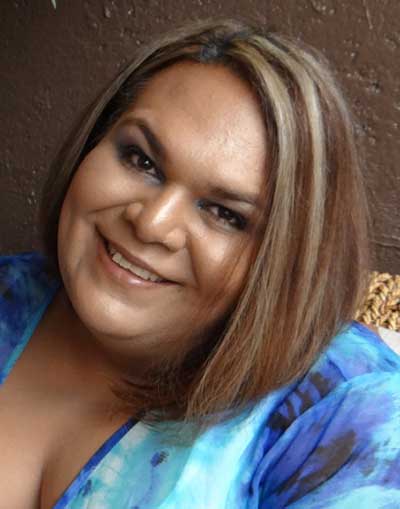
We interviewed Natasha in June 2015 during her visit in Geneva to attend the 29th session of the United Nationsan international organisation comprising 193 member States. It has the mission of maintaining peace and security, protecting human rights, providing humanitarian aid and ensuring economic and social development across the globe. It is a network of many different bodies and agencies, each of which has a particular role and responsibility. More Human Rights Councilan inter-governmental body within the United Nations which has the responsibility to promote and protect human rights. It is comprised of 47 member States, each elected to 3-year terms by the 193 member States of the United Nations. More.
Natasha, tell us something about yourself: where are you from and what do you do in your country?
Hello, my name is Natasha Jimenez and I am a transadjective/umbrella term to describe a person whose gender identity does not match the sex they were assigned at birth. More and intersexan umbrella term for the spectrum of variations of sex characteristics that naturally occur within the human species. Intersex people are born with variations of sex characteristics (such as genitals, reproductive organs, hormonal and chromosomal patterns) that are more diverse than stereotypical definitions of male or female bodies. Up to 1.7% of the global population are born with such traits; yet, because their bodies are seen as different, intersex children and adults are often stigmatised and subject to harmful practices – including in medical settings - and discriminated against. More activist. I am from Costa Rica and belong to an organization called Mulabi/ Latin American Space for Sexualities and Rights and I have been advocating for trans and intersex rights for about 30 years.
How did your involvement as a human rights defender start?
I started about 30 years ago, working in the care of people at the terminal stage HIV and AIDS infection because nobody within the heath staff was taking care of these people. They were put in a basement without any care; and a group of us managed to provide care for these people on a volunteer basis and to bathe them, feed them, give them their medication and give them emotional support, because they were people who had no contact with their families.
This is how my fight began, and in those years I also joined the feminist movement. Since then I have been working in different LGBTIacronym for lesbian, gay, bisexual, trans and intersex people. Although this is not the acronym available to describe people of diverse sexual orientations, gender identities and expressions, and sex characteristics, it is the most commonly used in United Nations spaces and advocacy. More organizations in my country, and for the last 10 years I have been the coordinator of Mulabi, and now I am also involved in ILGA.
You are in Geneva attending the 29th Session of the Human Rights Council. In this session intersex issues have been mentioned various times. How important is this to the intersex movement and for intersex children?
I think the most important thing about intersex issues being mentioned in such an important space as the Human Rights Council of the United Nations, is that it generates a very large impact on the visibility of the topic. There is still a lot of misinformation around intersex issues, but the fact that these are mentioned in such an important space gives intersex people visibility and is great for our movement, and I think this was one of the few times that high officials have spoken about these issues and I think it is one of the greatest achievements we have had in the United Nations. Moreover, the situation of intersex people in the different countries is receiving visibility.
If you had to tell activists about the most interesting events during the HRC session related to LGBTI issues, what would you talk about? What is the impact of being in Geneva and attending the session in person?
I think we should mention several spaces. One, at least in the time I have been in Geneva, was that a statement that was made in response to the report submitted by the Human Commissioner for Human Rights on female genital mutilation where intersex issues were also mentioned, and that was read here, in fact, I actually read it. Also there was the fact that I was part of a panel where intersex issues and the right to association of the LGBTI population were discussed, where I talked about the situation in Latin America and other partners talked about the situation in Africa and Oceania, etc.
So the issue was visible in the panel, but I think the biggest achievement or activity in which we have been working with various activists is against the Resolution on protection of the family, with the support of Colombia, Uruguay, Brazil and Chile, which are four Latin American countries that also pushed for the Resolution on Human Rights, Sexual Orientationrefers to a person’s capacity for profound emotional, affectional and sexual attraction to - and intimate and sexual relations with - individuals of a different gender or the same gender or more than one gender. More and Gender Identityrefers to a person’s deeply felt internal and individual experience of gender, which may or may not correspond with the sex assigned at birth. More. Being in the negotiations, the examination of the draft study and the presentation of the document, I think has been one of the most important spaces in recent days.
Your organization, Mulabi, was elected as the first ILGA intersex secretariat at the ILGA World Conference in Mexico City in 2014 and you represent the secretariat to the World Board and the global movement. I know you are always on the move, you were recently in Washington at General Assemblythe main deliberative and policy-making organ of the United Nations which makes decisions on international issues such as development and peace and security. All 193 member States are represented, and each has one vote. More of the Organisation of American States (OAS) and you will soon fly to France to attend an intersex forum, can you tell us more?
First of all, as director of Mulabi I’m very honored, as this is the first organization that was voted to represent the Intersex Secretariat, and happy because intersex people are represented within ILGA, although we already were before, but the fact that we now have a Secretariat gives more value to our movement. Thank you very much to ILGA for this.
As for the second part of the question, as you mention, I was recently in Washington, in fact I traveled to Geneva from Washington, and there I was representing the ILGA Intersex Secretariat at the General Assembly of the Organization of American States, and before that I was also at the Summit of the Americas in Panama. After Geneva I will be going to a film festival and intersex forum in Douarnenez, France, where I will also be representing the ILGA Intersex Secretariat. I know it sounds like hard work, and it really is, but I feel very happy for doing it.
(interview by Alessia Valenza)