Summary
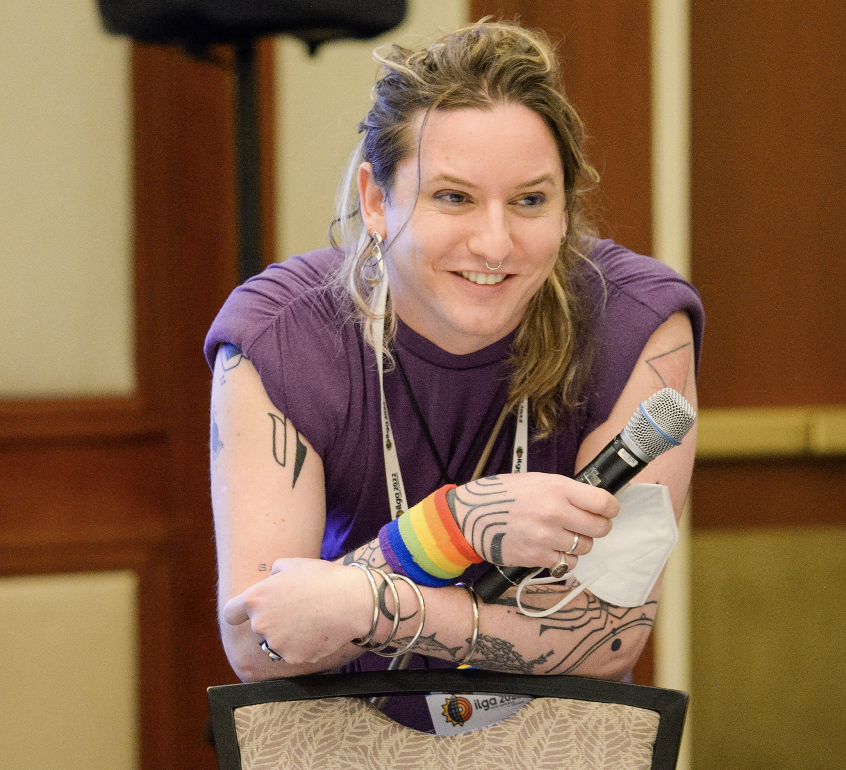
Our Manager of the Gender Identityrefers to a person’s deeply felt internal and individual experience of gender, which may or may not correspond with the sex assigned at birth. More, Gender Expressionrefers to how a person presents their gender through physical appearance – including dress, hairstyles, accessories, cosmetics – and mannerisms, speech, behavioural patterns, names and personal references. More and Sex Characteristicsa term that refers to physical features relating to sex - including genitalia and other sexual and reproductive anatomy, chromosomes, hormones, and secondary physical features emerging from puberty. More (GIESC) Programme here at ILGA World, Dennis van Wanrooji, penned a special message sharing their journey in identifying as non-binarya person who does not identify exclusively as a man or a woman. While many also identify as trans, not all non-binary people do. Non-binary can also be used as an umbrella term encompassing identities such as agender, bigender, genderqueer or gender-fluid. More and gives a look into the upcoming activities and strategic direction of the department.
My non-binary journey dates back to some of my oldest memories I have as a child. Like many queerpreviously used as a derogatory term to refer to LGBT individuals in the English language – and still perceived as offensive by some - queer has been reclaimed by people who identify beyond traditional gender categories and heteronormative social norms. Although not universally accepted, it is often used as a catch-all to include many people within the larger community of people with diverse sexual orientations, gender identities and expressions, and sex characteristics. More kids, I enjoyed playing with my mom’s clothes, makeup, and jewelry. I was even more obsessed with my Jewish grandmother’s wardrobe, a true fashion icon. The desire to explore and play with my genderrefers to a social construct which places cultural and social expectations on individuals based on their assigned sex. More was filled with guilt and shame at the time. Although I never wanted to conform to society’s gender, among other standards, I did it for many years due to lack of information and safety reasons. I had no references to non-binary and queer lives during my youth in Brazil.
In 2008, I started also dating gayadjective to describe people whose enduring physical, romantic, and/ or emotional
attractions are to people of the same gender. Men, women and non-binary people may use this
term to describe themselves. More men and non-conforming people, and it took me ten years to feel comfortable with my femininity again. During this time, I began my activism while also working as a sexrefers to the classification of a person as male, female, or other - usually made at birth, written on a birth certificate, and usually based on the appearance of their external anatomy. A person’s sex, however, is actually a combination of bodily characteristics, including chromosomes, hormones, internal and external reproductive organs, and secondary sex characteristics. More worker, and these experiences were critical to my process of growth and self-acceptance. Some of the most potent activists I met were transadjective/umbrella term to describe a person whose gender identity does not match the sex they were assigned at birth. More sex workers who had no shame or guilt. In 2018, I had all the tools, language, and community I needed to explore my gender freely again. I joined the Radical Faery community and dared to live beyond the binary. To me, being non-binary is an ongoing process of re-birth, self-love, and healing that I am lucky enough to live. It’s also a rocky road with many obstacles, but hey, let’s celebrate for once… because today is International Non-Binary People’s Day! And as ILGA World’s Manager of the Gender Identity, Gender Expression and Sex Characteristics (GIESC) Programme, I want to share some of our plans moving forward. The GIESC team is relatively new within ILGA World yet made up of world-class activists fighting for gender equality and justice for trans, gender diverse and intersexan umbrella term for the spectrum of variations of sex characteristics that naturally occur within the human species. Intersex people are born with variations of sex characteristics (such as genitals, reproductive organs, hormonal and chromosomal patterns) that are more diverse than stereotypical definitions of male or female bodies. Up to 1.7% of the global population are born with such traits; yet, because their bodies are seen as different, intersex children and adults are often stigmatised and subject to harmful practices – including in medical settings - and discriminated against. More people.
In the GIESC team, we all come from different backgrounds and lived experiences, countries, and regions, but we have an agenda in common that is guided by feminist principles. As much as we are concerned about the escalated violence, the global anti-gender backlash, and its immense impact on our communities, we are confident that by working with our members and allies, we are paving the way for a better future. Our first GIESC team strategy is currently being developed, and it will be pivotal to expanding our intersectional advocacy, research, and convening work. In this process, we value and welcome the community’s participation in every step.
With a spirit of unity and solidarity, we will work tirelessly to end violence, discriminationunequal or unfair treatment which can be based on a range of grounds - such as age, ethnic background, disability, and diverse sexual orientations, gender identities and expressions or sex characteristics, amongst others. More and human rights abuses directed at trans, gender diverse and intersex people.
Happy International Non-Binary People’s Day! You are valid and we love you.