Summary
This analysis stems from an update of a series of factsheets prepared by ILGA World and ISHR, which list the references and recommendations made regarding LGBTIacronym for lesbian, gay, bisexual, trans and intersex people. Although this is not the acronym available to describe people of diverse sexual orientations, gender identities and expressions, and sex characteristics, it is the most commonly used in United Nations spaces and advocacy. More persons and SOGIESCabbreviation standing for sexual orientation and gender identity & expression, and sex characteristics. More in communications, thematic reports and country visitsmissions carried out by UN Special Procedure mandate holders to assess the situation of human rights in a specific country. During their missions, they will meet with national and local authorities, national human rights institutions, as well as with NGOs, civil society, and survivors of human rights violations. Findings, conclusions and recommendations of such missions are published in reports to the Human Rights Council. More by mandate holders.
Overall, in relation to LGBTI topics, the thematic Special Proceduresindependent human rights experts within the UN Human Rights Council with mandates to report and advise on human rights from a thematic or country-specific perspective. They are non-paid and elected for 3-year mandates that can be re-conducted for another three years. Special procedures can undertake country visits, and act on individual cases of reported violations by sending communications to States and others. They also engage in advocacy, raise public awareness, provide advice for technical cooperation, and contribute to the development of international human rights standards.
More sent 19 new communications, issued 28 reports on country visits and published 39 thematic reports.
We welcome the ongoing attention these experts are paying to SOGIESC human rights issues, including particular attention to the situation of transadjective/umbrella term to describe a person whose gender identity does not match the sex they were assigned at birth. More people. For example, one communication concerned the dismissal of a soldier following her genderrefers to a social construct which places cultural and social expectations on individuals based on their assigned sex. More reassignment surgery, and another one was about a bill making it impossible for trans and gender diverse people to legally change their gender. We also commend the strong LGBTI focus adopted by the Special Rapporteur on truth, justice and reparation, as well as good reference to LGBTQI2S indigenous people by the Special Rapporteur on Indigenous peoples. We encourage mandate holders to further strengthen their analysis of specific populations within LGBTI communities, such as LBQ women, trans or intersexan umbrella term for the spectrum of variations of sex characteristics that naturally occur within the human species. Intersex people are born with variations of sex characteristics (such as genitals, reproductive organs, hormonal and chromosomal patterns) that are more diverse than stereotypical definitions of male or female bodies. Up to 1.7% of the global population are born with such traits; yet, because their bodies are seen as different, intersex children and adults are often stigmatised and subject to harmful practices – including in medical settings - and discriminated against. More persons and LGBTI persons with disabilities, and to look into the situation of LGBTI persons who are not necessarily activists.
Find out more about the trends in 2020 below! You can find the updated factsheets here.
Which experts include LGBTI issues most regularly?
The mandates that made the most regular references to SOGIESC issues were:
- the Independent Expert on violence and discriminationunequal or unfair treatment which can be based on a range of grounds - such as age, ethnic background, disability, and diverse sexual orientations, gender identities and expressions or sex characteristics, amongst others. More on the basis of SOGIabbreviation standing for sexual orientation and gender identity More (22 items: 2 SOGIESC-inclusive thematic reports, 1 country report and 19 communications on LGBTI relevant topics);
- the Special Rapporteur on human rights defenders (13 items);
- the Special Rapporteur on health (11 items);
- the Special Rapporteur on freedom of expression (10 items);
- the Working Group on discrimination against women (10 items);
- the Special Rapporteur on torture (10 items);
- the Special Rapporteur on violence against women (10 items).
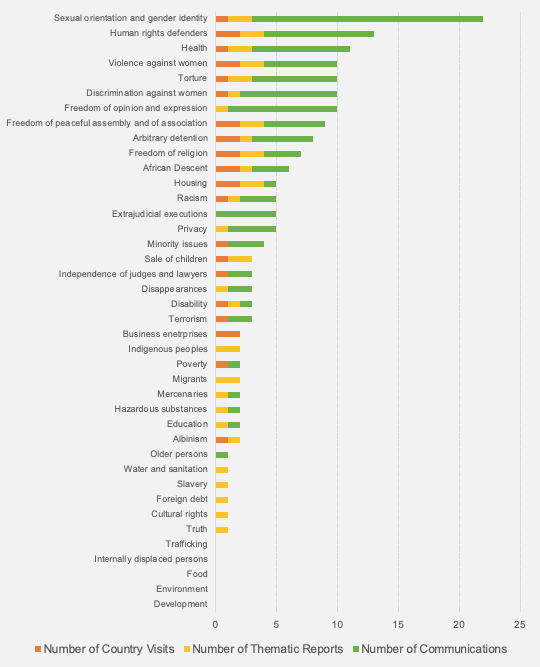
2020 SOGIESC thematic reports, country visits and communications by mandates
Communications
19 new communications on SOGIESC – letters concerning allegations of human rights violations – were sent by thematic mandates for the period from 17 December 2019 to 20 November 2020.
All 19 communications were made with the Independent expert on SOGI. The other top mandates were the Special Rapporteur on human rights defenders and the Special Rapporteur on freedom of expression (9 communications each), the Working Group on discrimination against women and the Special Rapporteur on health (8 communications each). In a welcome advance, four mandates (disappearance, minority issues, older persons and mercenaries) made their first communications covering LGBTI topics.
Communications covering SOGIESC issues were sent to 17 states from all UN geographical clusters: Bangladesh, Bulgaria, Cambodia, Egypt, Honduras, Hungary, Nepal, Netherlands, Republic of Korea, Romania, Saudi Arabia, Tunisia, Turkey, Uganda, United Republic of Tanzania, United States of America, and Zambia.
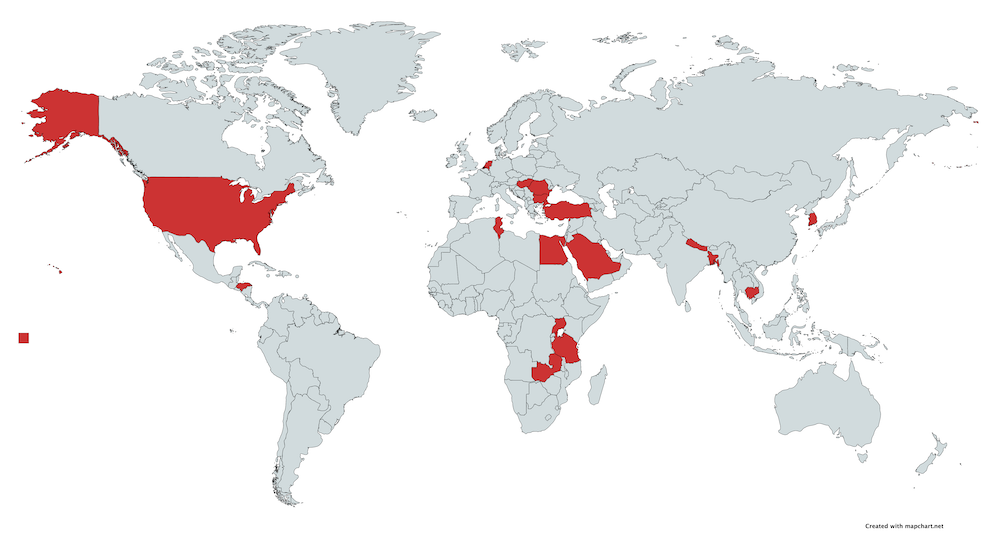
Countries that received communications
Country visits
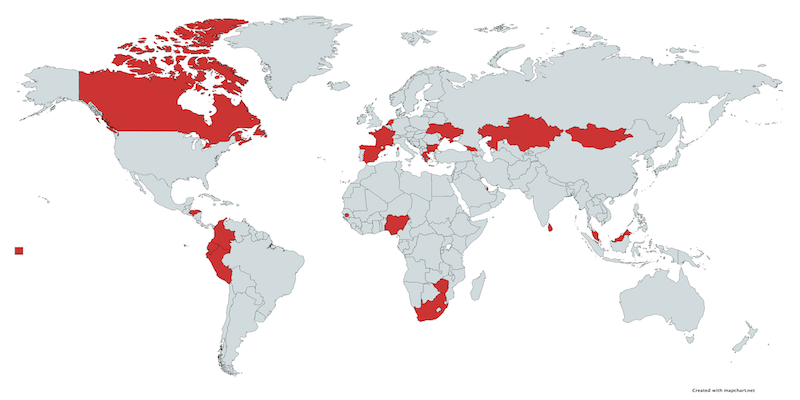
Due to the Covid-19 pandemic, the number of country visits has declined this year. However, because reports on country visits are usually published a year after the visit, in 2020 Special Procedures still presented 28 reports on country visits with references to SOGIESC. This covers 22 countries in all five UN geographical clusters.
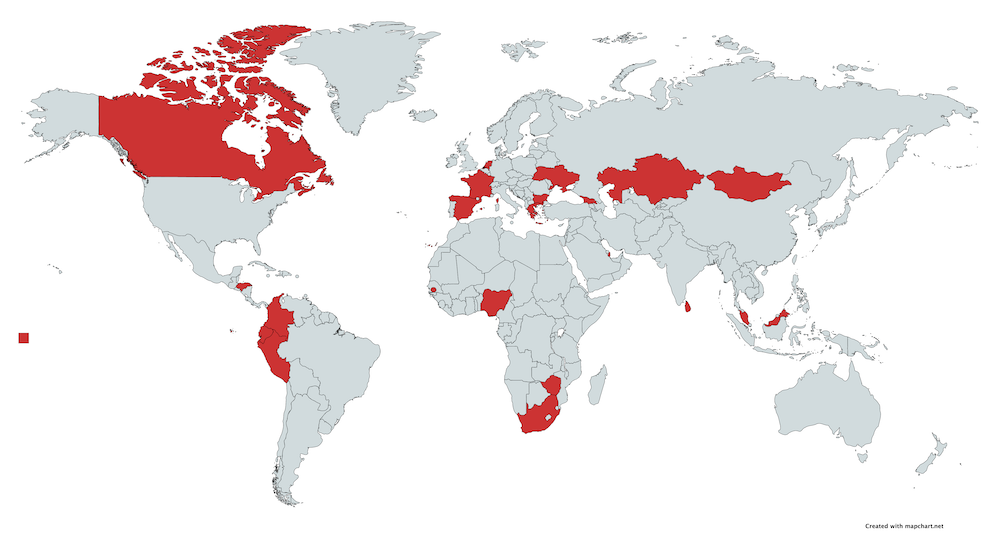
Country visit reports published
The countries include: Bulgaria, Canada, Colombia, Comoros, Ecuador, France, Gambia, Georgia, Greece, Honduras, Kazakhstan, Malaysia, Mongolia, Netherlands, Nigeria, Peru, Qatar, South Africa, Spain, Sri Lanka, Ukraine, and Zimbabwe.
Some of the mandates, particularly, the Special Rapporteur on the rights of persons with disabilities, and the Special Rapporteur on terrorism, presented their first SOGIESC-inclusive country reports in 2020.
Thematic reports
Special Procedures also included SOGIESC elements in their thematic reports to the Human Rights Councilan inter-governmental body within the United Nations which has the responsibility to promote and protect human rights. It is comprised of 47 member States, each elected to 3-year terms by the 193 member States of the United Nations. More and General Assemblythe main deliberative and policy-making organ of the United Nations which makes decisions on international issues such as development and peace and security. All 193 member States are represented, and each has one vote. More. In 2020, 39 reports (more than 50% of all thematic reports) mentioned some LGBTI related topics, with 12 of these reports – set out in the table below – including good or strong references to LGBTI populations.
2020 Thematic reports with good or strong SOGIESC references
| Mandate | Report topic | References |
| SPECIAL RAPPORTEUR IN THE FIELD OF CULTURAL RIGHTS | Cultural rights defenders January 2020 (41th Session Human Rights Council (HRC)) |
Good references to LGBT and SOGI (cultural rights includes LGBT rights, challenges defenders face and need for protection) Paras. 13, 27, 48, 52, 52, 53, 55, 63, 67, 77e |
| SPECIAL RAPPORTEUR ON THE PROMOTION AND PROTECTION OF THE RIGHT TO FREEDOM OF OPINION AND EXPRESSION | Artistic Freedom of Expression July 2020 (44th Session HRC) |
Good reference to LGBT, sexual minorities (suppression of LGBTQ activists, artists, and artistic events and expression) Para. 1, 28, 32-35. |
| SPECIAL RAPPORTEUR ON THE RIGHTS TO FREEDOM OF PEACEFUL ASSEMBLY AND OF ASSOCIATION | Celebrating women in activism and civil society: the enjoyment of the rights to freedom of peaceful assembly and of association by women and girls. July 2020 (75th Session General Assembly (GA)) |
Good reference to LGBTI (women with multiple and intersecting forms of marginalization, police violence and restrictions overseas funding) Paras. 26, 39, 41, 49, 50, 68, 71 |
| SPECIAL RAPPORTEUR ON FREEDOM OF RELIGION OR BELIEF | Freedom of religion or belief and Gender Equality August 2020 (43th Session HRC) |
Very strong reference to SOGI based violence and discrimination in the name of religion or belief. Paras. 16 – 76. |
| SPECIAL RAPPORTEUR ON ADEQUATE HOUSING AS A COMPONENT OF THE RIGHT TO AN ADEQUATE STANDARD OF LIVING, AND ON THE RIGHT TO NON-DISCRIMINATION IN THIS CONTEXT | COVID-19 and the right to adequate housing July 2020 (75th Session GA) |
Strong references to LGBT, transgender and gender-diverse persons, and SOGI. (A separate section on LGBT persons’ right to housing during the pandemic; a recommendation on data collection.) Paras. 45-46, 68a. |
| SPECIAL RAPPORTEUR ON ADEQUATE HOUSING AS A COMPONENT OF THE RIGHT TO AN ADEQUATE STANDARD OF LIVING, AND ON THE RIGHT TO NON-DISCRIMINATION IN THIS CONTEXT | Guidelines for the implementation of the right to adequate housing December 2019 (43rd Session HRC) |
Good references to LGBTI and “sexual identity”. (Vulnerability and discrimination in housing.) Paras. 33a, 44, 48d(v). |
| SPECIAL RAPPORTEUR ON THE RIGHTS OF INDIGENOUS PEOPLES | The impact of COVID-19 on the rights of indigenous peoples July 2019 (75th Session GA) | Good references to LGBTQI2S and SOGI (example from Thailand; recommendation to pay attention to the situation of indigenous LGBTQI persons; call to collect and analyze data on indigenous LGBTQI and two-spirit persons in the health-care system; no discrimination based on SOGI.) |
| SPECIAL RAPPORTEUR ON THE RIGHT TO PRIVACY | Summary of activities on surveillance, health data, business enterprises use of personal data and protection against gender-based privacy infringements February 2020 (43rd Session HRC) |
Good references to SOGIESC. (Considerations of the right to privacy of people with diverse SOGIESC in relation to treatment of persons deprived of their liberty; changing rooms and health related data) Paras. 15, 20d, 24, 27aii, 37lii, 39c, 41axi, 54ai. |
| INDEPENDENT EXPERT ON PROTECTION AGAINST VIOLENCE AND DISCRIMINATION BASED ON SEXUAL ORIENTATIONrefers to a person’s capacity for profound emotional, affectional and sexual attraction to - and intimate and sexual relations with - individuals of a different gender or the same gender or more than one gender. More AND GENDER IDENTITYrefers to a person’s deeply felt internal and individual experience of gender, which may or may not correspond with the sex assigned at birth. More |
“Conversion therapies” practices May 2020 (44th Session HRC) |
Explores practices of so-called “conversion therapy”pseudo-scientific and harmful practices used to attempt altering a person’s gender expression, gender identity or sexual orientation, based upon the wrong assumptions that any diversity is intrinsically disordered and can/should be changed. More across the globe, including their impact on victims, their human rights implications and their connection with violence and discrimination based on sexual orientation and gender identity, as well as measures adopted to prevent them and to penalize or prosecute those who perform them and remedies provided to victims. |
| INDEPENDENT EXPERT ON PROTECTION AGAINST VIOLENCE AND DISCRIMINATION BASED ON SEXUAL ORIENTATION AND GENDER IDENTITY |
COVID-19 July 2020 (75th Session GA) |
Discusses the impact of the coronavirus disease (COVID-19) pandemic on the human rights of LGBT and gender-diverse persons, communities and/or populations; analyses the impact of the pandemic on social exclusion and violence and the interaction with institutional drivers of stigma and discrimination; analyses measures adopted in the context of the pandemic aimed at persecuting LGBT and gender-diverse persons or with indirect or unintended discriminatory effects and identifies good practice. |
| SPECIAL RAPPORTEUR ON THE PROMOTION OF TRUTH, JUSTICE, REPARATION AND GUARANTEES OF NON-RECURRENCE | The gender perspective in transitional justice processes July 2020 (75th Session GA) |
Strong reference to LGBTI. Gender perspectives considered in conceptualization, design and implementation of national transitional justice strategies and mechanisms. Para.10-114. |
| SPECIAL RAPPORTEUR ON VIOLENCE AGAINST WOMEN, ITS CAUSES AND CONSEQUENCES |
Violence against women journalists May 2020 (44th Session HRC) |
Good references to lesbians, LGBT people, LBTI women, LT journalists, LGBTI issues. (In the context of attacks, abuses and harassment experienced by journalists, and retaliation for covering certain issues.) Paras. 46, 51, 54, 57. |