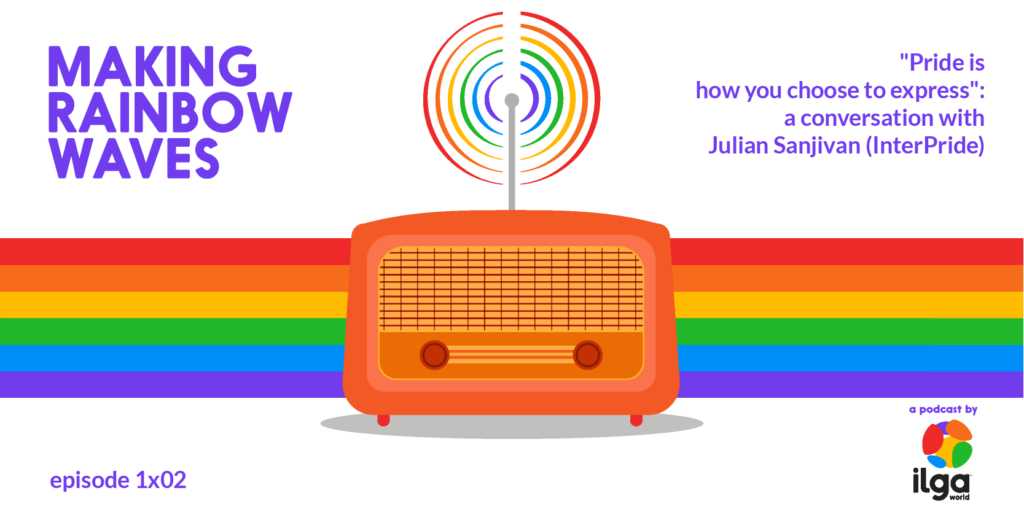
How has the Covid-19 pandemic been affecting the Pride movement? And how are Pride organisers making it through its unprecedented challenges?
On the occasion of Pride Month, we met with Julian Sanjivan to find out more for a new episode of Making Rainbow Waves, the podcast by ILGA World.
Julian is the co-president of InterPride – the global federation bringing together Pride organisations from around the world, as well as regional, national, and local Pride networks.
Together we talked about their personal story, the resilience of a movement that found new ways to come together at a time of global disruption, and about how Pride is a fundamental human rights component. “The fact that we rose up and we fought back, because we were being oppressed: how can it not be us advocating for our community?”, Julian told us. “I think we need to take a moment and recognise that this is part of the human rights work that we do.”
Making Rainbow Waves is a podcast by ILGA World, telling the stories and raising the voices of LGBTI human rights defenders worldwide.
Listen to the episode and subscribe to Making Rainbow Waves via Google Podcast – Apple Podcasts (coming soon) – Spotify – Deezer – Stitcher – TuneIn – Ausha
Transcription by Nazlı Mayuk
Making Rainbow Waves, a podcast by ILGA World.
Welcome everybody to Making Rainbow Waves, a podcast by ILGA World telling the stories and raising the voices of LGBTI human rights defenders worldwide.
My name is Daniele Paletta, and in this episode, we are going to talk about Pride.
We have a special guest: Julian Sanjivan, who is the co-president of InterPride, the global organisation that brings together Pride organizations from around the world, as well as regional, national, and local Pride networks. We came together to talk about their personal story, how the Pride movement has made it through the Covid-19 pandemic, and so much more. Here’s what they told us.
I first wanted to start by asking about your personal story. And how did you get into activism for LGBTI rights and into the Pride movement?
That’s a great question. I was actually born in Malaysia, I grew up in Malaysia, I’ve been in the United States now for, on August will be exactly, nine years. I got my asylum granted here in the United States. Back in Malaysia, I started my career doing a lot of feedbacks, training programmes, etc. I even started on my own company, focusing on corporations and all of that. I’ve gotten into advertising. But, at some point in my life, I realised, this is not what I really want to do, I really want to be able to give back to the community, and as I started accepting myself more. But I think being in a country like Malaysia, it was very difficult. We don’t have the type of legal environments that just really allow for us to be up and around screaming proudly that we’re gay. It’s just a very dangerous environment, to be really out and open. So, knowing that being part of the community, and I felt like that’s where my passion lies, I started volunteering. I started volunteering with a non-profit called the PT Foundation. It’s one of the biggest non-profits in Malaysia, dealing with HIV and AIDS. And they also work with a lot of the community on gender, sexuality. Issues around HIV, and AIDS is the priority.
And so, by volunteering, conducting training sessions, I realised it’s really what I was passionate about. So, I gave up my corporate job, got into non- profit world, I became the HR director, and eventually I was there for a few years. But through that experience, I realised the challenges that we had to deal with, with the authorities, with the government. There were some really scary moments that we’d actually experienced, I personally experienced too. I think, at that point, when I really wanted to start doing activism more actively: I started noticing violations that the community that we were serving… And so, given the work that we were doing, I realised how much of a problem and challenge they faced with authorities. For example, if there were sex workers, and if they were transgender, and also doing sex work, the experience with the authorities was really awful. So, I started noticing a lot of this kind of violation.
And so, to me, it was very frustrating even though I was doing HR, but you know, I started doing a lot of programmatic stuff. And I started getting into advocacy and all of that, and started getting meetings together with the local police authorities to bring awareness and how can we address this? So, a lot of those things. So yeah, I think that’s when it really started and moving to the United States just started focusing a lot more on issues pertaining to the community. And being an immigrant myself, and having having been granted asylum, I’m really passionate about working for the community issues that affect the community as well. And of course, being a person of colour myself and non-binary, those are also issues are very personal to my heart.
Thanks for sharing your story with us. And how did you come to InterPride? And can you tell us a little bit more about what InterPride is and does?
InterPride is actually, it’s pretty much an umbrella organisation, for Pride organisers around the world. And thus, InterPride, it’s international Pride. And we represent about 400 members from about 70 different countries from around the world. And, of course, through our Pride Radar Initiative, where we try to identify where the Prides are around the globe, we recognise there are anywhere between 1200 to 1500 Pride organisations around the world. And Pride looks very different. And so even though we may have 400 active organisations who are members, but we’re technically representing all of these Pride organisations. And so, InterPride, our focus is bringing Pride organisations together, networking, education, support, standing in solidarity, advocating for issues that’s affecting the community that we serve… so these are the core areas of the things we focus on, and that’s what we do.
We are almost 100% volunteer run, we used to be for many, many years. We recently brought in part time help just two weeks ago, our leadership team is from all of the different continents, various countries, very diverse team. And so, we’re really proud of that. Of course there’s always room for improvement, but we represent our global audience. Some of the work that we’re doing and have done in the past include World Pride. World Pride is our signature event, we own the brand. We licence it to different cities. So, this year, it’s going to be in Copenhagen in 2021. And, Copenhagen is focusing a lot on human rights as well in their event. And the 2023 is in Sydney, Australia, we’re really proud that. This is the first time it’s going to a country in the southern hemisphere, which we’ve never really hosted before. And so, there are bidders for future hosts.
And then we have Global Pride, we hosted Global Pride for the firsttime last year: There was an opportunity to bring folks together from around the world, on a virtual platform: when the pandemic happened it affected a lot of us in the community quite significantly. Pride is an opportunity for us to come forward, come together, for a lot of people it’s when they come out, and that was taken away with the pandemic. And it’s also important to understand the members that we serve are not just big names like New York City Pride, Sydney Mardi Gras, or Paris and London. No, there are so many of them that are really small Pride organisations in small towns and regions that some of us may not even have heard of, and they could look very different, they could be a picnic or a cycling event.
Depending on where you are in the world, Pride looks different because of culture and law. So, Global Pride really brought all of these people together, virtually, hundreds of different entries with nearly 60 million viewers, so that’s something that we did, and we raised a lot of money, and we gave back to a lot of the Pride organisers. Because essentially, people need to understand that Pride organisers – even though they are an organisation – they represent an entire community that they’re serving. A lot of our members are organisations that are one-stop centres, they provide multiple services, and Pride celebrations are just one of them.
ROPE, which is a racism and oppression awareness programme is something that we introduced last year, to really talk about racism and oppression, that’s a major issue. That’s been around for centuries. But really, it’s with the George Floyd incident, the death of George Floyd, and how that brought about the Black Lives movement was a lot more visible around the world, not just in the United States. And so, racism and oppression became a major discussion around the world. And that’s something that we wanted to embark on, to educate our members, support and share resources. So, these are just examples of many more – like the Solidarity Fund, which we created to support folks around the world. And so, these are things that are InterPride. And that’s what InterPride is about.
[Musical interlude]
Starting from 2020, the whole world has been battling with the consequences of the Covid-19 pandemic. Many were left struggling to survive in a world that has become even more unequal and violent. LGBTI communities were left particularly vulnerable. In many places where laws were already a cause of inequality, things have only got worse. We asked Julian how have Pride organisers made it through 2020, and what is the situation for the Pride movement at the moment.
I think 2020 was a disaster for all of us. I mean, it just happened so quickly. And everyone around the world is just taken by surprise. It really affected us significantly. And, it was so close to Pride season, too. And I think for a lot of people that uncertainty showed. People were starting off with “okay, we’re going to have a march, we’re going to have this Pride festival, we’re going to have concerts” and all of that stuff. And then everything had to change. Some people already signed up sponsors, signed up vendors, secured locations, and brought planning to bring in temporary staff members.
Everything had to change overnight. At first, I think people like, what do we do? How do we go about it? We cannot just not do anything, Pride still needs to happen. And, so there’s a lot of conversation around exploring virtual components started. I think it is a very quickly, there’s the progression. And I must say, Pride organisers, generally, we are a very resilient bunch. I think generally the LGBTQIA population, we just have to be resilient, given out difficult situation that we’re in, the discrimination, and all of the struggles that we face, we’re just naturally resilient and strong.
So, we just came up we had to come up with solutions and figure out and keep moving on that way. It didn’t mean that it didn’t impact us, I think there’s a lot of emotional psychological impact on so many different levels, the trauma of it all, just knowing that things are happening so quickly, you’re losing a lot of stuff very quickly, whether it’s employees, the possibility of not knowing whether your organisation will be around anymore, not being able to come together and meet people. Especially for the queer community at large, the LGBTQIA+ community, we rely a lot on our chosen families, and not being able to interact with each other was significant.
Now a year, more a little bit more than a year in 2021, for many of us, in certain parts of the world, there’s hope. For the first time with the introduction of vaccinations and the effectiveness of other testing and social distancing, and all of that. We’re seeing results, especially through vaccination. Also, it’s important to keep in mind that some of us are more privileged.
And so, I think for Pride organisers, looking at all of this, let’s hope we can start planning. The one thing I feel that strongly 2020 impacted is, how can we make our events more accessible for folks who have never really had the opportunity to be actually part of the celebrations because with doing in virtual, we have literally opened up our events to the whole world: folks from the Middle East, folks from parts of Africa, South America, Asia, Eastern Europe,People who don’t really get to do a lot of this suddenly visible and able to see this, and they’re also able to share and organise their own. And so, that impact is so significant. And that’s something that people want is to try and do more and still keep doing, and that’s something that I feel is really important, a lesson that we all have, or at least something precious – the silver lining, if I may say from the pandemic – that we’ve come up with come out of.
A lot of folks are looking at hybrid events. That’s becoming a major discussion. And that’s good, that’s really, really good because it makes us more accessible. But at the same time, the reality of it is that many of our LGBTQIA family around the world don’t have the same privilege. For them, they’re still thinking about safety and their health. So, I think it’s important for us to also think about that for a second, and what can we do to support.
Another trend that I’m also noticing is a lot of the Pride organisers are looking at, okay, let’s give a little bit more time, let’s plan to do virtual in-person events later this year. So, we’re starting to see a significant increase in numbers, in terms of in-person events that are going to be happening in September, October and November. Most events tend to happen around this time of the year, but a lot of events that in-person events are moving towards the end. Because they still want to make sure that we have a responsibility to make our events safe. Safety is a priority.
I see. And, and yeah, you mentioned Global Pride, and I can only imagine how great but also stressful on the organising side it must have been for all of you involved. Yeah, I wanted to ask if you have a memory of that. If you had to share with like, one memory of the day, what would that be?
I remember being very emotional. And I’m trying so hard not to get emotional right now. Because there’s a lot of work. And knowing how the pandemic it affected every one of us in here, including myself, seeing all of the celebrations and people coming together online, was just phenomenal.
When it started, I remember watching and then crying, because I was just so emotional, seeing all of it come together. And then I went and slept for like a couple of hours came back and I was watching again and I was crying again. It’s just tears of joy and tears of just being overwhelmed and seeing all of this complicates… I remember that distinctly but also remember how I’m just looking at how Pride is celebrated and the representation, looking at folks from the Middle East, folks from Southeast Asia, folks from Africa, communities putting the content out there. Being in the United States for nine years now, I’m used to seeing how Pride looks like here, for a while now. I haven’t had the privilege to travel to many parts of the world, especially in the global south for Pride. I was in India last year, just before the pandemic, to celebrate Pride in Mumbai. And it was a very interesting experience, it was my first time to India, I’ve never been there and seeing just how the community was celebrating was really, it was an eye-opening experience for me as well.
So, seeing all of that online, the dances, the representation and the different way people were expressing that it was so empowering. So, so empowering, and that’s why I was overwhelmed. We did this, like: we put this together in such a short period of time, with the entire world watching. almost 60 million people. It was a lot. And it’s a sense of achievement that I think it’s important to recognise because it was a community coming together to do this together.
One very important topic remained to be discussed in this conversation: the connections between the Pride movement and broader human rights work. Here’s what Julian told us.
I have the feeling that sometimes, the very visible moments of Pride, like the marches and all the events, sometimes kind of overshadow all the human rights work that the Pride movement does – also in the eyes of our communities. And, of course, we know that’s not the case. So, my question to you was: How do Pride and human rights work connect?
Both are not mutually exclusive. They’re not. I mean, Pride is a human rights component. When you think about it, the Stonewall uprising, a year after the Stonewall uprising, the first part much has happened here in New York City and many other cities around the country here in the United States. You know, in parts of the world that’s still used as a major landmark, even in Germany, for example, they still call it the CSD (Christopher Street Day). And so, it has had its impact. And that is human rights, the fact that we, we rose up and we fought back, because we were being oppressed, how can it not be us advocating for our community? So, that’s why I think we need to take a moment and recognise that this is part of the human rights work that we do.
Going out there organising in an environment that you have so many different resistance is not easy. It’s about visibility, it’s about making people know we’re here, we’re queer, and we’re proud. And that is a huge component of what human rights is about. The fact that in many parts of the world, people can’t even do that, and they want to do that and they arrested or they are killed for being even, for even trying to do that. It’s a human rights violation by itself.
So, the ability for us to speak up and have a voice heard in a platform like Pride is about human rights, at the end of the day. I don’t think human rights is just sitting in the United Nations and having your voice heard. And, it’s not just about making legislation, legislative change. Yes, don’t get me wrong: all of these are very important, it has to happen. But they all work together, we all work together, we all come together, and we do our parts.
We are trying to do more, we are hoping that in the years to come, we will have more formal representation in specific decision-making organisation at the global level that can really uplift the community a lot more and more of a voice. But in the meantime, we’re still going to do what we do, bringing Pride organisations together and keep uplifting them, so that they in turn, can do what they’re doing in terms of human rights, which is letting people organise Pride for the community. Because it’s what brings us together, whether you’re protesting, whether you’re celebrating. Pride is how you choose to express.
I think all of this and, all of the work that you Pride organisers do deserve the recognition because it really brings all the community together. So, thank you for sharing that. Thank you so much, Julian, for being here with us today and for all the conversation, and I hope we will continue to be working together for our communities.
Thank you so much for having me, Daniele, this is amazing. And I enjoyed talking to you. Thank you for all of the work that you that you do as well. Y’all are doing such an amazing work. I must say like even my presentation that I did, and I do regularly talk to people, I use a lot of information from ILGA. So, thank you for the work that you all do.
Thank you so much.
Making Rainbow Waves is a podcast by ILGA World. This episode was hosted by Daniele Paletta, and edited by Nazlı Mayuk. You can find every episode on all streaming platforms or on ilga.org. Thanks for listening.