Summary:
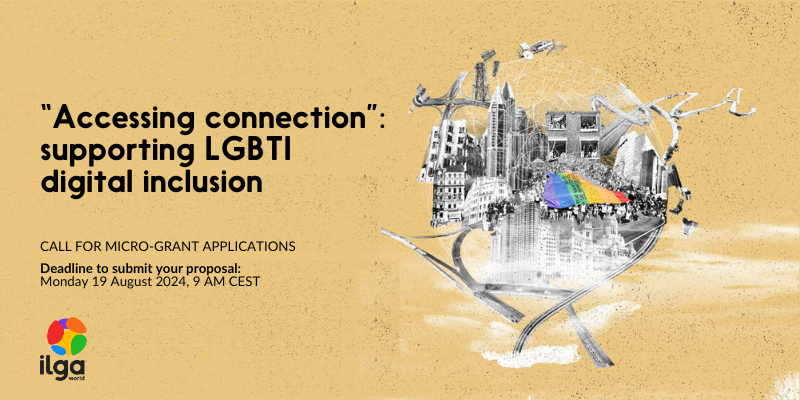
ILGA World is inviting organisations working at the local and/or national levels to submit project proposals to advance digital inclusion for lesbian, gay, bisexual, trans, and intersex (LGBTI) communities.
We will provide financial support to help develop 10 of these projects, by issuing micro-grants of a maximum of CHF 3,000 for each.
The call is open to organisations and/or coalitions led by or focusing on the rights of persons of diverse sexual orientations, gender identities and expressions, and sex characteristics (SOGIESC) from any country or territory across the world.
Deadline for project proposals: Monday 19 August, 9 AM CEST
For people of diverse SOGIESC, the online space has helped create community, spearhead movements, and provide tools to be heard — including in very hostile environments.
However, these possibilities are not equally available for everyone. To date, 2.6 billion people across the world remain offline. For the rest of the global population, accessing digital resources depends on overcoming barriers based on intersecting aspects of their identities.
Researchers have mapped the complexities of the digital divide across multiple perspectives. However, little to no global research has explored the hurdles it poses to LGBTI people.
To fill in this gap, ILGA World partnered with The Engine Room — a non-profit supporting civil society in its use of technology — for a pioneering research project. Released in February 2024, Accessing Connection analyses the complex interplay between disparities in digital access and the unique experiences of LGBTI individuals and communities.
The research showed that there is no single narrative around how LGBTI people around the world access connection. While online connectivity has transformed our work as organisations and presence as individuals, it created a vicious cycle as well: those who are most vulnerable and economically deprived are also the most difficult to reach and support. They are at the same time most affected by the harms of online surveillance, censorship, and harassment, and this deprives them of crucial opportunities for advocating their rights and building community. Follow this link to read the main findings of the Accessing Connection report.
Submit your project proposal towards LGBTI digital inclusion: micro-grants are available!
Despite the hurdles to digital inclusion, grassroots organisations serving have found multiple ways to reach out to the least connected within LGBTI communities.
These initiatives have historically included facilitating access to internet services, organising digital security and literacy training, translating LGBTI-related materials into local languages, and harnessing online spaces to mobilise against hostile legislation or gather the community – amongst many others.
To help them strengthen their work in this field, ILGA World is inviting organisations working for LGBTI communities at the local and/or national levels to submit project proposals to advance digital inclusion for all.
ILGA World will provide financial support to help develop 10 of these projects, by issuing micro-grants of a maximum of CHF 3,000 (three thousand Swiss Francs) for each project.
The projects supported by these micro-grants must aim to
- reduce the impact of the digital divide on LGBTI communities and organising
- equip rightsholders to address local advocacy and movement-building gaps created by the digital divide through training, technical support, research, and monitoring
and/or to
- empower local and national organisations to conduct advocacy at multiple levels
Project proposals must
- be submitted by organisations led by or focusing on the rights of persons of diverse SOGIESC at the local or national level, based in any country or territory worldwide
- include an outline of proposed activities, and describe how the project would benefit the target communities.
All proposed projects will have to be developed between 2 September and 15 November 2024, with reports to be submitted before 5 December 2024.
Examples of projects that would be taken into consideration
To better help you propose your projects, we are providing just a few examples of initiatives that might be considered for these micro-grants:
- purchasing devices and data packages for grassroots LGBTI community members or organisations
- improving the accessibility of an organisation’s online platforms and content to better serve LGBTI community members living with disabilities
- offering material, psychological, and legal support to LGBTI survivors of online harassment and gender-based violence
- organising trainings to improve local LGBTI communities’ digital security and literacy
- hiring translators and designers to make LGBTI content more accessible for local communities and overcome a few languages’ predominance over others on the internet
- organising awareness campaigns or outreach initiatives targeting LGBTI people and communities in rural, remote, or least-connected areas.
The call is open to any organisation led by — or focusing on — the rights of persons of diverse SOGIESC.
Although we particularly encourage organisations from the Global South and East to present their projects, groups seeking to receive support through this micro-granting initiative can based in any country or territory across the world.
Proposals submitted by a coalition of organisations are also eligible. Organisations may also submit more than one project proposal, although only one project proposal per organisation will be taken into consideration.
Among the criteria to select projects to assign micro-grants to, ILGA World will consider:
- relevance to the subject matter
- engagement with under-represented populations within the LGBTI community, including
- LGBTI people living in rural or remote areas, or locations with limited internet connectivity
- LGBTI people with disabilities
- Racialised LGBTI people
- Lesbian, bisexual, trans, and intersex women
- LGBTI sex workers
- previous experience in organising initiatives to support LGBTI or other communities’ digital inclusion
- feasibility of the project between 2 September and 15 November 2024
- proven understanding by the proposing organisation(s) of how intersectional dimensions of the digital divide are affecting the communities they serve
- key indicators about the digital divide in the area or country targeted by the project — including those related to infrastructure, affordability, and gender
Thursday 1 August: opening of micro-grant applications
Monday 19 August (9 AM CEST): deadline to submit project proposals
Monday 26 August – Sunday 1 September: project proponents are notified of the selection outcome
Monday 2 September – Friday 15 November 2024: organisations awarded with micro-grants develop their projects
Thursday 5 December 2024: deadline for organisations awarded to submit their final report about the project.
How to apply
The project proposal must be submitted exclusively through an online form. Please follow this link to submit your project proposal.
We recommend you download the application form in Word format from here, prepare your proposal, and copy/paste your answers into the online form.
In case an organisation wishes to propose more than one project, they are required to prepare an online form submission for each project proposal.
The project proposal must be submitted by Monday 19 August at 9 AM Central European Summer Time (CEST). Please prepare your proposal in due time: late submissions will not be considered.
Only in case of well-founded reasons why the online form cannot be used as a submission method, please download the application form and send it to media (a) ilga (dot) org. Please indicate “LGBTI digital inclusion project proposal” in the email subject.
Should you have questions regarding this call, please reach out to media (a) ilga (dot) org.
“We know that being online is not the only way to serve our populations. And yet, ensuring meaningful and safe connectivity could open up a whole new avenue of opportunities, especially for those whose voices the digital divide contributes to maintaining unheard. Reaching out to those systemically marginalised — by the digital divide or otherwise — remains at the core of the promise to leave no one behind.”