Summary
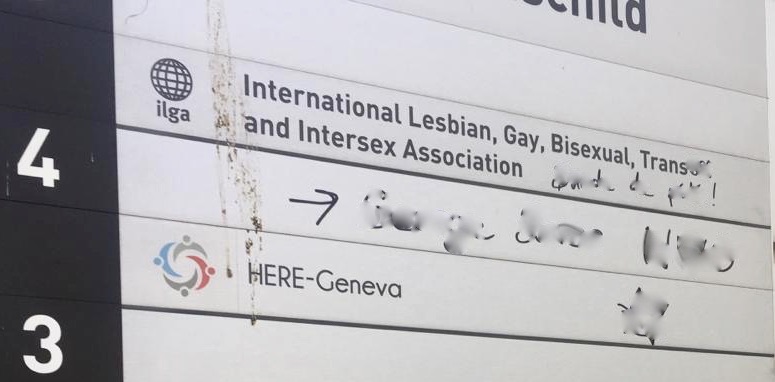
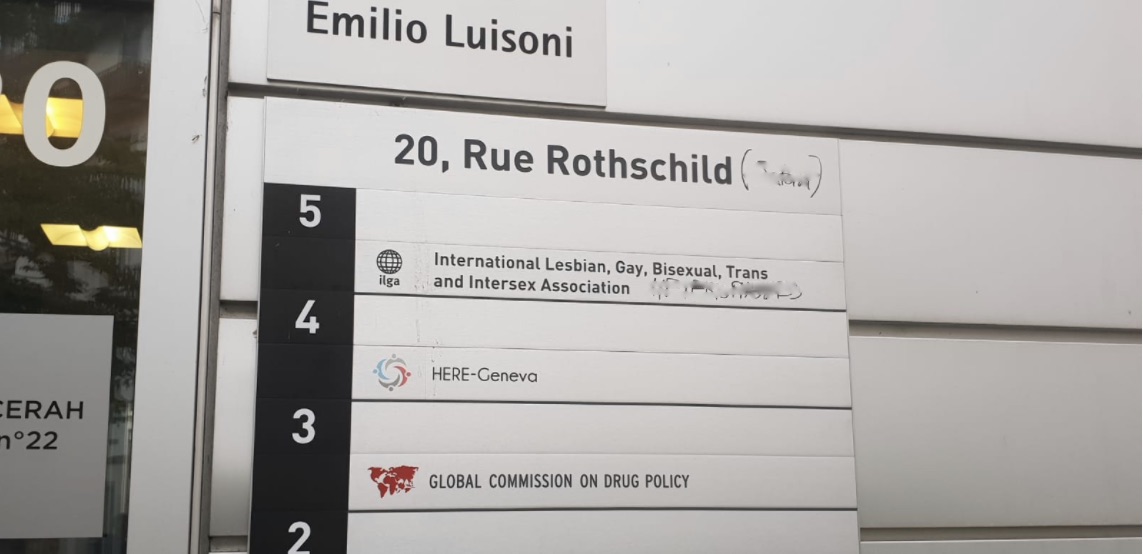
Anti-Semitic, transphobic, nationalist conspiracy theory, and homophobic slurs were tagged on ILGA World’s name on two separate occasions over the past three months.
The incidents took place just steps away from the Office of the United Nationsan international organisation comprising 193 member States. It has the mission of maintaining peace and security, protecting human rights, providing humanitarian aid and ensuring economic and social development across the globe. It is a network of many different bodies and agencies, each of which has a particular role and responsibility. More High Commissioner for Human Rights, in a neighborhood with a primary school, a college and other human rights NGOs.
Together with ILGA World, the Ligue internationale contre le racisme et l’antisémitisme (LICRA), the members of Geneva’s Federation of LGBT associations – 360, Dialogai, Lestime, Parents d’homos, Think Out – and Geneva Pride –La Marche des fiertés de Genève 2019 – strongly condemn the hateful, anti-Semitic, LGBTI-phobic and discriminatory vandalism incidents.
ILGA World is a worldwide federation of organisations committed to equal rights for LGBTIacronym for lesbian, gay, bisexual, trans and intersex people. Although this is not the acronym available to describe people of diverse sexual orientations, gender identities and expressions, and sex characteristics, it is the most commonly used in United Nations spaces and advocacy. More people. Founded in 1978, it represents over 1,500 member organisations from 152 countries and territories. Every year, ILGA World welcomes hundreds of LGBTI human rights defenders to Geneva, supporting them as they raise the voices of local rainbow communities at the United Nations.
“We have clearly been targeted for the work that we do – just as happens to many in our communities from across the world”, commented Kseniya Kirichenko, a Russian lawyer who works as ILGA World’s Senior Officer on Women and UN Advocacy. “It is particularly concerning to see this in Geneva, the city of human rights where I myself have found a safe space having formerly lived in Russia where we also experienced this kind of attacks on our work.”
ILGA World has filed a complaint against the anti-Semitic inscriptions and for property damage.
LGBTI-phobic insults, aggressions and incitement to hatred and violence towards the LGBTI community in Switzerland are unfortunately present in the media, in public spaces, schools or community centres, at work and within families. Youth are particularly exposed to violence: 50% of LGB persons under 25 reported being subjected to at least one form of homophobic violence in the last 6 months; almost 9 in 10 transadjective/umbrella term to describe a person whose gender identity does not match the sex they were assigned at birth. More students have been insulted and 55% have been physically bullied at school[1].
As homophobic and transphobic comments made in general terms are not currently punished by the Swiss Penal Code, aggressions and incitement to hatred and violence that happened on these grounds can’t be recorded as such by police.
In December 2018, Switzerland proposed to include sexual orientationrefers to a person’s capacity for profound emotional, affectional and sexual attraction to - and intimate and sexual relations with - individuals of a different gender or the same gender or more than one gender. More (but leaving out gender identityrefers to a person’s deeply felt internal and individual experience of gender, which may or may not correspond with the sex assigned at birth. More) as protected grounds against bias-motivated speech in Article 261bis of the Criminal Code. A request for a referendum against this revision was filed a few weeks later and Swiss voters may have to decide on this.
We note once again the urgent need to supplement article 261 bis of the Swiss Penal Code in order to allow the condemnation of such hate statements: the existing gap does not currently allow us to file a complaint noting the homophobic and transphobic nature of the inscriptions. We call on Swiss national parliamentarians to address this as an urgent matter, otherwise similar incidents will simply fall outside the law.