Summary
an article by
Tess McEvoy (ISHR) and Gabriel Galil (ILGA World)
So much can change in just ten years.
Certainly, in the past ten years we have witnessed seismic advances in the recognition of rights of LGBTIacronym for lesbian, gay, bisexual, trans and intersex people. Although this is not the acronym available to describe people of diverse sexual orientations, gender identities and expressions, and sex characteristics, it is the most commonly used in United Nations spaces and advocacy. More persons at the United Nationsan international organisation comprising 193 member States. It has the mission of maintaining peace and security, protecting human rights, providing humanitarian aid and ensuring economic and social development across the globe. It is a network of many different bodies and agencies, each of which has a particular role and responsibility. More Human Rights Councilan inter-governmental body within the United Nations which has the responsibility to promote and protect human rights. It is comprised of 47 member States, each elected to 3-year terms by the 193 member States of the United Nations. More.
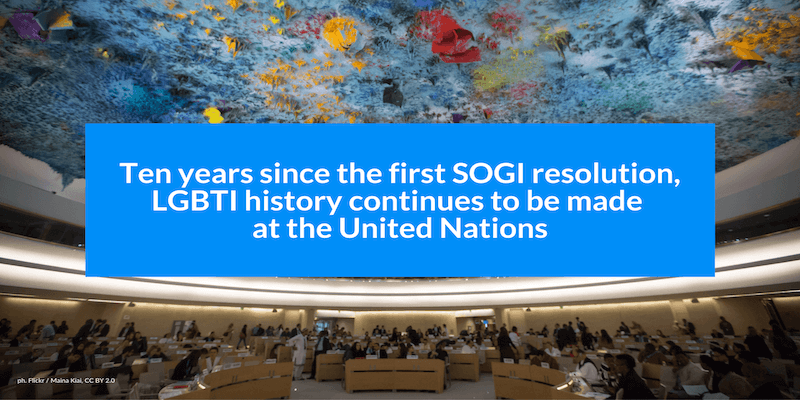
In June 2011, exactly ten years ago, South Africa led a coalition of States requesting the UN High Commissioner for Human Rights to document “discriminatory laws and practices and acts of violence against individuals based on their sexual orientationrefers to a person’s capacity for profound emotional, affectional and sexual attraction to - and intimate and sexual relations with - individuals of a different gender or the same gender or more than one gender. More and gender identityrefers to a person’s deeply felt internal and individual experience of gender, which may or may not correspond with the sex assigned at birth. More (SOGIabbreviation standing for sexual orientation and gender identity More)”.
This was the first time a UN human rights body passed a resolution on the rights of our communities. The call was supported by countries from all regions of the world, which meant that a majority of the Council demanded an investigation into the way international human rights lawa legal system laying down obligations which States are bound to respect. By becoming parties to international treaties, States assume obligations and duties under international law to respect, protect and fulfil human rights – including by putting into place domestic measures and legislation. Where domestic legal proceedings fail to address human rights abuses, mechanisms and procedures for individual complaints or communications are available at the regional and international levels to help ensure that international human rights standards are respected. More can be used to end violence and abuses against people on the grounds of their sexual orientation and genderrefers to a social construct which places cultural and social expectations on individuals based on their assigned sex. More identity.
The resolution resulted in a report published in December 2011, in which the UN, for the first time, documented human rights violations against people of diverse sexual orientation and gender identities. The world had to listen.
At the time LGBTI human rights defenders commented that by “publishing this report the United Nations has unequivocally affirmed that the protections guaranteed by the Universal Declaration of Human Rights apply to each and every one of us.”
It took a long time to get there. It started in 1984 when more than 1000 LGBT persons marched towards the UN headquarters in New York demanding an end to violence and to discriminatory immigration laws, as well as the declassification of homosexuality as a disease.
Six years later, on May 17 1990, the World Health Organisation – a UN agency – finally said it loud and clear: homosexuality is not a mental illness. We continue to celebrate the International Day against LGBTI-phobia on that day! However, it fell short in making the same move when it comes to transadjective/umbrella term to describe a person whose gender identity does not match the sex they were assigned at birth. More identities: such declassification would only be achieved in 2018 and officially adopted one year later.
Since that moment, our communities have continued to express themselves and have their voices heard within the UN. LGBTI organisations have been providing information and data, engaging with and taking the floor with UN human rights bodies. In 1994, the UN Human Rights Committee ruled that sodomy laws violate international laws. One year later, lesbianadjective/noun to describe a woman whose enduring physical, romantic, and/or emotional attraction is to other women. Women and non-binary people may use this term to describe themselves. More women were an important presence at the Beijing World Conference on Women. In 2008, 66 member States openly declared their concerns about violations of rights based on SOGI. And in 2011, Colombia led 85 States in a statement urging the Human Rights Council to address these important human rights issues.
The first adopted SOGI resolution, however, marked a significant turning point. Since that moment, the UN has continued to issue reports documenting human rights violations against our communities, and over the years, activists have continued to speak proudly and openly in UN meetings, pushing for change on the ground.
In 2014 a second resolution followed, this time led by a core group of Latin American States. And in 2016, another milestone was reached: the UN created a specific mandate to address violence and discriminationunequal or unfair treatment which can be based on a range of grounds - such as age, ethnic background, disability, and diverse sexual orientations, gender identities and expressions or sex characteristics, amongst others. More on the basis of sexual orientation and gender identity. The Council then voted to renew this crucial human rights expert’s position in 2019, with a record number of supporting votes and co-sponsorship by 52 States from all regions of the world. The renewal of the SOGI mandate was supported by 1,312 civil society organisations from 174 States and territories, showing how crucial the SOGI mandate has been in the work of our communities around the world.
In 2020, in another historic first, 36 States from all regions of the world came together during the 45th session of the Human Rights Council to call on all States “as a matter of urgency, to protect the autonomy of intersexan umbrella term for the spectrum of variations of sex characteristics that naturally occur within the human species. Intersex people are born with variations of sex characteristics (such as genitals, reproductive organs, hormonal and chromosomal patterns) that are more diverse than stereotypical definitions of male or female bodies. Up to 1.7% of the global population are born with such traits; yet, because their bodies are seen as different, intersex children and adults are often stigmatised and subject to harmful practices – including in medical settings - and discriminated against. More adults and children and their rights to health, and to physical and mental integrity so that they live free from violence and harmful practices”, as stated by the Permanent Mission of Austria on behalf of the 36 States. The cross-regional joint statement is a landmark in the work of the Council on raising awareness about the human rights of persons of diverse sexrefers to the classification of a person as male, female, or other - usually made at birth, written on a birth certificate, and usually based on the appearance of their external anatomy. A person’s sex, however, is actually a combination of bodily characteristics, including chromosomes, hormones, internal and external reproductive organs, and secondary sex characteristics. More characteristcs.
Today, during the 47th session of the UN Human Rights Council, States came together and announced the formation of a Group of Friends of the mandate of the UN Independent Expert on SOGI: an important commitment to continue focus on specific human rights situations facing our communities, and to defend their rights from mounting attacks and hostility.
“The Group is ‘an informal partnership of countries composed of 27[1] States working together proactively in the context of the Human Rights Council in support of the work of the mandate of the Independent Expert on SOGI’”, as stated by the Permanent Mission of Argentina during the Interactive Dialogue with the mandate holder today, on behalf also of Chile and Uruguay.
The Group aims to support the work of the Independent Expert on SOGI (IE SOGI), make collective statements, organise and co-sponsor events to raise awareness about violence and discrimination on the basis of sexual orientation or gender identity, make collective diplomatic efforts for the renewal of the mandate, and cooperate and support the work of civil society partners.
In the report presented today, the IE SOGI provides an analysis of the current state of international human rights law in relation to the recognition of gender, and gender identity and expression, in connection with the struggle against violence and discrimination in its different forms.The report also concludes that gender-based approaches and legal recognition of gender identity and expression provide the human-rights based framework to fulfil those duties in international law.
Reacting to the report, the Permanent Mission of Uruguay, on behalf of the Group of Friends welcomed its presentation and said that it “contributes to a better understanding of the existing connection between the equal enjoyment of human rights by womens, girls, LGBT, and gender diverse and intersex persons, considering that violence and discrimination against persons belonging to these groups have common root causes” and also stated that “we highlight the importance of advancing legal gender recognitionlaws, administrative procedures or processes by which a person can change their sex/gender marker and names on official identity documents. More based on self-identification.”
As we look forward, we will continue to work together toward enhanced respect, dignity, equality and a world free from violence and discrimination for our communities, for everyone!
[1] Argentina, Chile, Uruguay, Australia, Austria, Belgium, Canada, Costa Rica, Denmark, Greece, Finland, Germany, Iceland, Israel, Ireland, Italy, Liechtenstein, Luxembourg, Malta, Mexico, Norway, Netherlands, Portugal, United Kingdom, United States, Sweden, Switzerland.