Summary
Shaping a world where everyone can live safely, equally and free is no easy task.
But we are in this together. And, despite the setbacks and alarming news, there are reasons for hope.
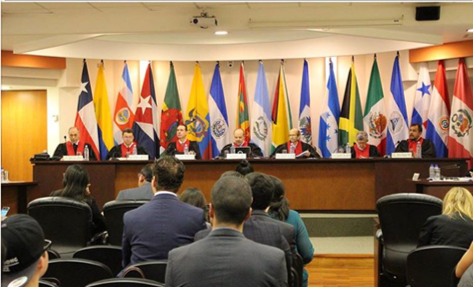
(ph. Facebook / Corte Interamerica de Derechos Humanos)
During these past few months, the Inter-American Court of Human Rights has recognised same-sex couples’ right to marriage and the right to legal gender recognitionlaws, administrative procedures or processes by which a person can change their sex/gender marker and names on official identity documents. More.
Canada delivered an historic apology to rainbow communities, and significant advances have happened in the legal struggle against the criminalisation of same-sex sexual activity in India.
Marriage equalitywhere national marriage legislation also includes same-sex couples or gender-neutral reference to the spouses. References to “gay marriage” that are sometimes made by media outlets and decision-makers incorrectly are incorrect, as no country has created a marriage law specifically for same-sex couples. More has become the law of the land in Australia, and in Austria the Constitutional Court has removed barriers to it.
A new regional network of intersexan umbrella term for the spectrum of variations of sex characteristics that naturally occur within the human species. Intersex people are born with variations of sex characteristics (such as genitals, reproductive organs, hormonal and chromosomal patterns) that are more diverse than stereotypical definitions of male or female bodies. Up to 1.7% of the global population are born with such traits; yet, because their bodies are seen as different, intersex children and adults are often stigmatised and subject to harmful practices – including in medical settings - and discriminated against. More human rights defenders was born in Asia. In Chile, the Chamber of Deputies approved the Gender Identityrefers to a person’s deeply felt internal and individual experience of gender, which may or may not correspond with the sex assigned at birth. More Bill, and in Botswana the Registrar issued a transadjective/umbrella term to describe a person whose gender identity does not match the sex they were assigned at birth. More man a new identity document to correctly reflect his genderrefers to a social construct which places cultural and social expectations on individuals based on their assigned sex. More identity.
Together, we are part of this good news. Together, we are bringing about change.
FROM THE UNITED NATIONS
A special shoutout goes to Lara Goodwin for her months of amazing work as an intern
supporting the UN Programme focusing on Treaty Bodies and Special Proceduresindependent human rights experts within the UN Human Rights Council with mandates to report and advise on human rights from a thematic or country-specific perspective. They are non-paid and elected for 3-year mandates that can be re-conducted for another three years. Special procedures can undertake country visits, and act on individual cases of reported violations by sending communications to States and others. They also engage in advocacy, raise public awareness, provide advice for technical cooperation, and contribute to the development of international human rights standards.
More.
Throughout these past months, ILGA continued to work at the United Nationsan international organisation comprising 193 member States. It has the mission of maintaining peace and security, protecting human rights, providing humanitarian aid and ensuring economic and social development across the globe. It is a network of many different bodies and agencies, each of which has a particular role and responsibility. More, mobilising support for SOGIESCabbreviation standing for sexual orientation and gender identity & expression, and sex characteristics. More issues globally. Grassroots movements are having their voices raised as we assisted and trained dozens of activists leaning on this universal forum to advance their rights.
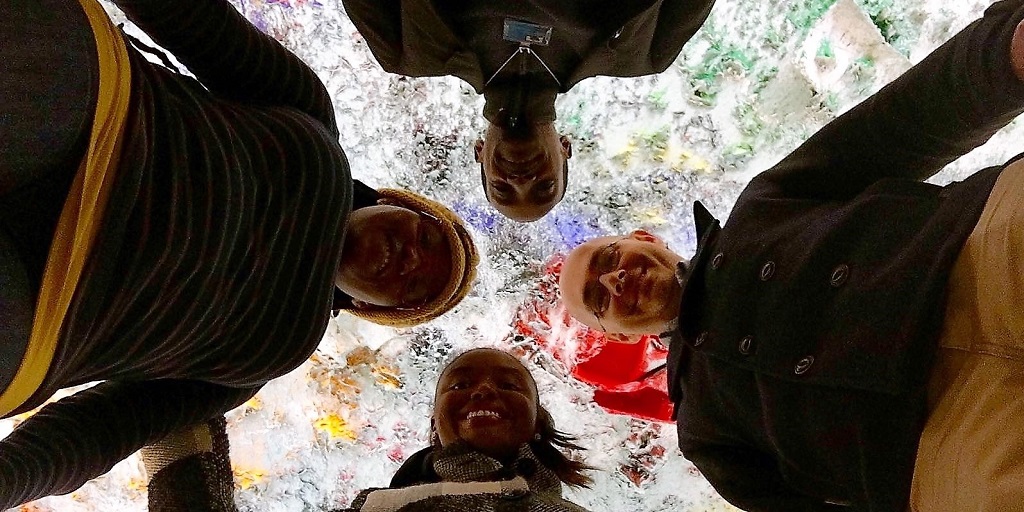
(A group picture for the human rights defenders who attended the SOGIESC UPR Advocacy Week
in December 2017)
ILGA began its year at the United Nations by monitoring closely the 29th UPR Working Group session: 100 SOGIESC recommendations were made to States under review, and three European countries received their first recommendations on intersex issues.
We continued to provide input and guidance on the work of many Special Procedures: here you can find out more on their latest 10 SOGIESC-related communications.
We committed to focus our Treaty Bodies work in 2018 on lesbian and bisexual women, to break the invisibility that their experiences face in international fora, and to produce a set of guidelines for LGBTIacronym for lesbian, gay, bisexual, trans and intersex people. Although this is not the acronym available to describe people of diverse sexual orientations, gender identities and expressions, and sex characteristics, it is the most commonly used in United Nations spaces and advocacy. More defenders to effectively use this part of the UN mechanism.
Our Gender Identity and Gender Expressionrefers to how a person presents their gender through physical appearance – including dress, hairstyles, accessories, cosmetics – and mannerisms, speech, behavioural patterns, names and personal references. More Programme has also worked to prepare our participation in the 62nd session of the UN Commission on the Status of Women, which will focus on achieving gender equality and the empowerment of rural women and girls. The LBTI Caucus will be there to hold governments accountable for all women.
The current session of the UN Human Rights Councilan inter-governmental body within the United Nations which has the responsibility to promote and protect human rights. It is comprised of 47 member States, each elected to 3-year terms by the 193 member States of the United Nations. More will also see a few areas of particular interest for LGBTI advocacy within the plenary discussions. We will follow HRC37 closely, and we have already started working on a few side events: stay tuned!

Are you planning to engage with an United Nations body?
Here are the dates and deadlines you need to consider for the Universal Periodic Review, Treaty Bodies or Special Procedures. Don’t hesitate to get in touch with us: we are ready to assist you!
ON THE BOOKSHELVES
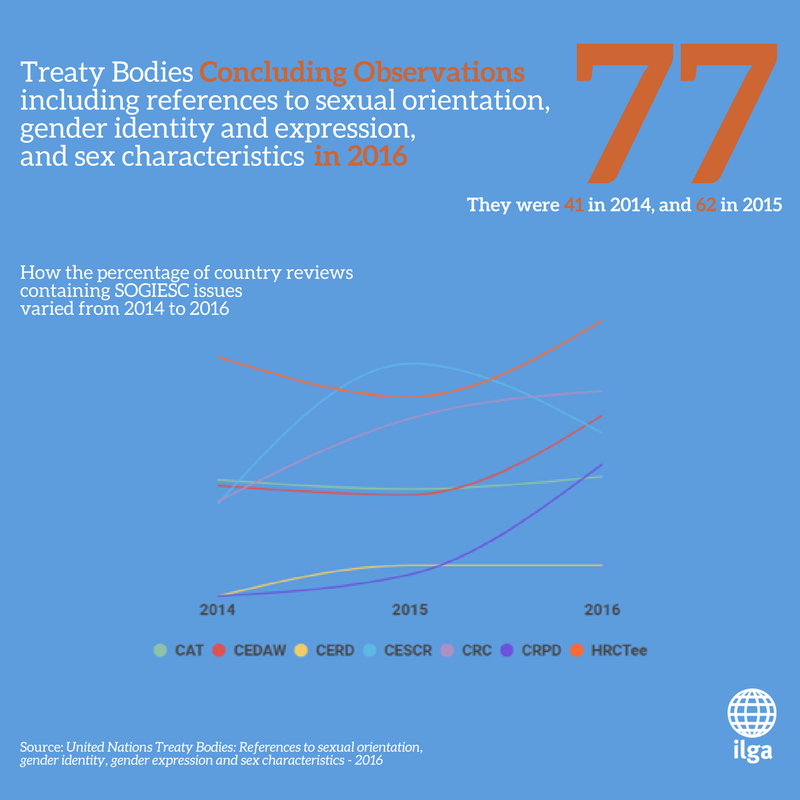
Sexual orientationrefers to a person’s capacity for profound emotional, affectional and sexual attraction to - and intimate and sexual relations with - individuals of a different gender or the same gender or more than one gender. More, gender identity and expression and sex characteristicsa term that refers to physical features relating to sex - including genitalia and other sexual and reproductive anatomy, chromosomes, hormones, and secondary physical features emerging from puberty. More are increasingly on the human rights agenda of the United Nations. In 2016 alone, the Treaty Bodies have issued 77 Concluding Observationsobservations and recommendations issued by a treaty body after it has considered a State party’s report and reports submitted by civil society organisations and had a dialogue with the State. More including SOGIESC, and that figure has almost doubled compared to 2014. Our latest Treaty Bodies annual report has more data for you to indulge in.
While casting a light on the legal situations worldwide for trans and gender-diverse people to change their sexrefers to the classification of a person as male, female, or other - usually made at birth, written on a birth certificate, and usually based on the appearance of their external anatomy. A person’s sex, however, is actually a combination of bodily characteristics, including chromosomes, hormones, internal and external reproductive organs, and secondary sex characteristics. More/gender markers and names on official documents, our latest Trans Legal Mapping Report has also shown what these laws mean in reality, thanks to interviews with in-country trans activists.
ILGA has recently also partnered with all its regions and 14 civil societies organisations worldwide to share insider knowledge and answer all your questions regarding how can LGBTI defenders engage in the Universal Periodic Review. The result is a very simple toolkit that every activist should have when working on the UPR!
More collaborations with other NGOs lead to a joint report detailing the road towards the confirmation of the UN SOGIabbreviation standing for sexual orientation and gender identity More Expert mandate over the 2016 UN General Assemblythe main deliberative and policy-making organ of the United Nations which makes decisions on international issues such as development and peace and security. All 193 member States are represented, and each has one vote. More.
These and more of our most recent resources offer a snapshot of laws, jurisprudence and public attitudes affecting our communities worldwide. We also made them more easily accessible thanks to a fully-renewed website, and we hope they will be useful for your work!
IN YOUR COMMUNITY
As 2017 got ready to wave goodbye, our rainbow community gathered together in Warsaw, Guatemala City and Phnom Penh, as three of our regions held their conferences. We were there, too, taking an active part in a number of pre-conferences, and guiding workshops on effective advocacy strategies.
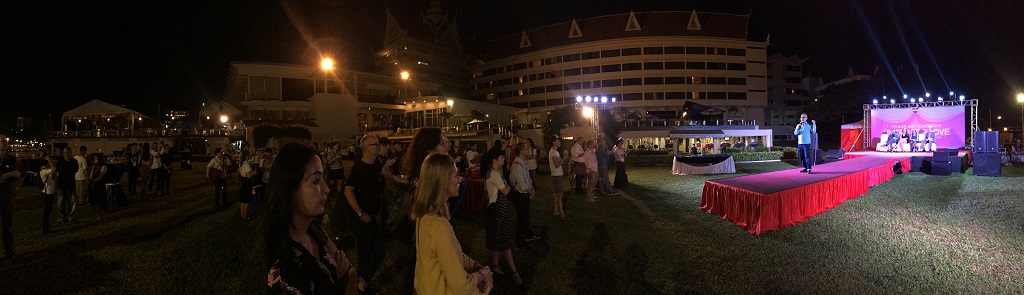
(The 2017 Trans Legal Mapping Report was officially launched during the ILGA Asia conference in Phnom Penh)
We welcomed human rights defenders to Geneva for advocacy experiences at CEDAW and around the Universal Periodic Review, where we could literally witness positive change as we were speaking.
ILGA is also offering a full-time internship opportunity: we are looking for an intern who will assist the work of our Gender Identity and Gender Expression programme. There is until February 28, 6 PM Central European Time to apply!
Pan Africa ILGA is preparing for its next conference: the deadline for registration, scholarship applications and abstract submissions is February 28!
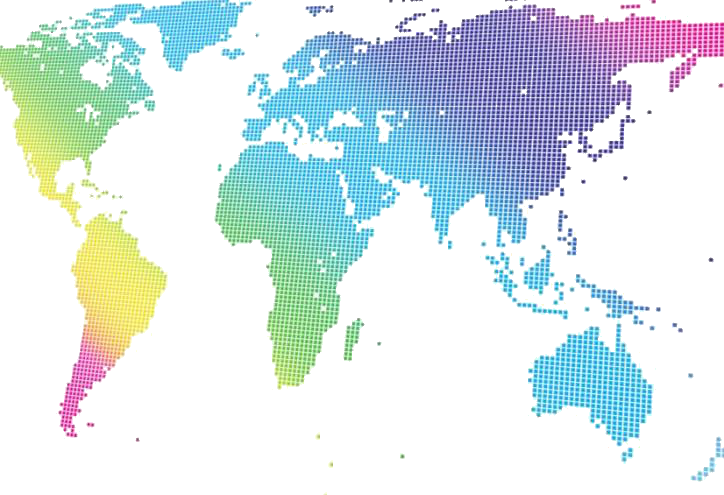
Meanwhile, the ILGA family has further grown in numbers and representation: 1,304 organisations from 142 countries across the globe now form this organisation committed to advance LGBTI rights worldwide.
You can join us, too! Become a member
Help us support LGBTI communities and organizations around the world through advocacy, education and research.
Your donation helps grassroots movements build capacity and have a voice in global fora.

[1] Lesbianadjective/noun to describe a woman whose enduring physical, romantic, and/or emotional attraction is to other women. Women and non-binary people may use this term to describe themselves. More and Bisexualadjective used to describe a person who has the capacity to form enduring physical, romantic, and/ or emotional attractions to those of the same gender or to those of other genders. More Women: ILGA’s focus for UN Treaty Bodies work in 2018
UN Treaty Bodies proved to be a living mechanism under which SOGIESC human rights standards have been significantly developed during last decades. At that, we have seen a progress in the development of approaches regarding trans and intersex communities, and trans and intersex groups themselves became more visible and organised.
At the same time, specific lesbian and bisexual women’s experiences remain invisible. For instance, in 2016 there was only one specific lesbian reference by the Human Rights Committee, and no recommendations aimed particularly at LB women. LB women defenders themselves stress that they do not have resources to organise international advocacy and need trainings and support in the preparation of shadow reports.
For these reasons, in 2018 we are focusing strategically on the promotion of LB women’s advocacy before Treaty Bodies and particularly CEDAW. The intention is to provide similar targeted focus on other population groups in future years.
If you are working on LB women’s rights in the countries mentioned below and wish to get ILGA’s support in your engagement with the UN Treaty Bodies, please contact Kseniya Kirichenko, the UN Programme Officer, at kseniya@silga.com.
We are looking for LB defenders from Angola, Antigua and Barbuda, Australia, Bahamas, Botswana, Colombia, Congo, Cook Islands, Cyprus, Ethiopia, Laos, Liechtenstein, Mauritius, Mexico, Nepal, New Zealand, Samoa, Serbia, State of Palestine, Tajikistan, The former Yugoslav Republic of Macedonia, Turkmenistan and the UK.
What else ILGA will do regarding UN Treaty Bodies in 2018?
In 2018, we will produce a set of practical guidelines for LGBTI defenders on how to engage with UN Treaty Bodies. There will be a general guide, as well as several documents with the information on specific Committees.
We will also publish the next annual report on Treaty Bodies to see what were the achievements and victories in 2017, and what are still remaining gaps.
Last but not least, we will also produce a policy paper on strategic litigation before the UN Treaty Bodies. In this publications, you will find information about existing jurisprudence on LGBTI rights and pending cases, advantages and disadvantages of these mechanisms, and opportunities for different countries and regions.
If you have been involved before in Treaty Bodies advocacy and wish to contribute to preparation of the publications, please contact Kseniya Kirichenko, the UN Programme Officer, at kseniya@silga.com.